

8 Game-Changing Manufacturing Trends That Will Define 2025
20 January 2025
The manufacturing sector is no stranger to innovation. In fact, it’s always been at the forefront of digital transformation, taking the arrival of robotics, the internet and new developments in material science in its stride.
However, in 2025, it still finds itself braced for disruption, as manufacturers around the world grapple with the implications of artificial intelligence. There’s also the growing importance of improving sustainability as the climate crisis deepens and building resilience in the face of political and societal uncertainty.
In order to meet these challenges, the companies responsible for creating products we use every day are enthusiastically investing in breakthrough technologies as well as adapting to cultural changes, such as the need to rethink skills and training.
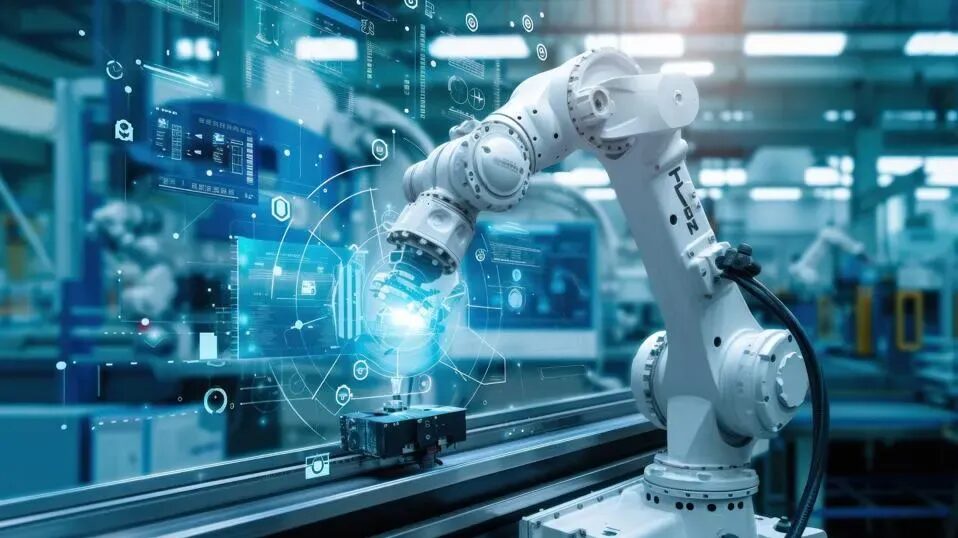
So let’s take a look at how this will unfold over the next year by overviewing the key trends and opportunities:
Generative AI: Reimagining Manufacturing And Design
In 2025, we will see manufacturers rolling out many use cases for generative AI designed to speed up and drive efficiency in manufacturing processes. By leveraging the power of generative design, it will be possible to create stronger, lighter components that make more efficient use of available materials. We’ve already seen aerospace companies leveraging genAI to create new aircraft parts, and automotive manufacturers are using it to optimize vehicle designs. I believe we will see many more innovative use cases in the coming year as manufacturers increasingly integrate genAI into their operations.
Smarter Robots
Robots are not new in manufacturing; in fact, robots have been working in factories for more than 50 years. What is new, however, is the new generation of intelligent robots that are able to work safely and effectively alongside humans, apply themselves to different tasks, and learn to become more efficient at their jobs and navigating their environments. As robots move away from the assembly line and into the workforce, humans will develop new skills around leading and interacting with automated co-workers – sometimes referred to as “cobots”.
Leadership In The AI Era
Positioning a business as a leader rather than simply a follower or even a laggard in the AI era will become a growing priority for many manufacturing companies. Put simply, it’s no longer good enough to simply adopt new technologies like robotics, predictive maintenance and automation. As the barriers to entry continue to fall, it has to be done in a way that’s more innovative, effective and efficient than the competition. Developing the capacity not just to follow trends but to identify opportunities to blaze a trail will increasingly become a priority in 2025.
Sustainability In Manufacturing
There are numerous reasons why sustainability is quickly becoming a business priority for manufacturers in 2025. They include consumer demand, stricter regulations and the simple fact that we’re increasingly seeing the impact of climate disruption in the world around us. Due to this, we can expect to see a strategic switch towards cleaner and greener operations, such as the use of renewable energy, recyclable materials, reductions in emissions, excessive packaging, and water use.
Building The Manufacturing Workforce Of Tomorrow
There’s a widely-acknowledged skills crisis among industries hoping to reap the opportunities offered by AI, robotics, advanced data analytics and automation. Bridging this skills gap will require manufacturers to rethink the way they hire and train staff, and for many, this will become a critical business priority in 2025. Addressing this challenge may involve investing in upskilling and reskilling, developing apprenticeship programs or forging new relationships with educators and academia.
Dark Factories
This year, smartphone manufacturer Xiaomi switched on its fully autonomous dark factory close to Beijing, capable of producing 10 million handsets a year without human intervention. This model will become increasingly common as manufacturers chase improved efficiency, sustainability and reduced waste. While “lights out” factories have been around for a while, Xiaomi’s factory is the first that is able to learn how to operate more efficiently and optimize its own processes thanks to its AI-powered “brain”.
Adopting And Adapting To The “AI First” Culture
There can undoubtedly be cultural barriers to AI adoption. Some people are worried it will replace them or make them redundant, while others believe that decision-making shouldn't be left to machines. While these are all valid concerns, identifying areas where AI can clearly solve problems or create efficiencies while mitigating its potential for causing harm will be a priority for the manufacturing industry in 2025. This will include planning and delivering initiatives fostering an understanding of AI across a workforce and ensuring its benefits are felt by all.
Smart Supply Chains
The logistical challenges around sourcing components and managing complex inventories and production infrastructure are perfectly suited to automated, intelligent solutions. AI-powered tools leveraging real-time data analytics will enable more accurate demand forecasting and automated decision-making, helping manufacturers to build supply chains that are more resilient and adaptive to changing market conditions. In 2025, AI will enable manufacturers to anticipate disruption more effectively and identify opportunities to improve efficiency, ultimately leading to improved customer experience and business performance.
As we move through 2025, the manufacturing sector stands at a pivotal moment of transformation. While challenges around AI adoption, sustainability, and workforce development remain significant, the convergence of smart technologies, automated systems, and sustainable practices is creating unprecedented opportunities for innovation. Companies that successfully navigate these changes – embracing AI-driven efficiency while building resilient, sustainable operations and investing in their workforce – will be best positioned to thrive in manufacturing's next era. The future of manufacturing isn't just about automation and AI – it's about creating smarter, more sustainable, and more adaptive production systems that can meet the challenges of tomorrow.

Related Articles

The Hidden Costs Of AI Data Centers, And Who Really Pays
Behind every AI chatbot query and autonomous agent action sits a data center, and the biggest ones consume staggering amounts of[...]
The AI Agent Boom Has A Trust Problem. Here’s How Business Leaders Can Fix It
The most expensive mistake your company makes next year could come from an employee who never sleeps, never takes a holiday[...]

AI Is Making Us Faster. So Why Aren’t Businesses More Productive?
Paid partnership with Atlassian AI is becoming remarkably good at helping us complete individual tasks faster. AI can now write code,[...]
The Top 7 Technology Trends For 2026
Technology is moving into a new phase in 2027, and once again AI sits at the center of it. But this[...]

AI Is Growing Up: What World Summit AI 2026 Revealed About The Future Of Business
The AI industry is entering a new phase, where autonomous agents, business transformation, governance and human wisdom are taking center stage.[...]
How AI, Drones And Autonomous Vehicles Are Transforming The British Army
The British Army is entering a new era in which soldiers will increasingly fight alongside drones, robots and AI-powered systems. I[...]

Sign up to Stay in Touch!
Bernard Marr is a world-renowned futurist, influencer and thought leader in the fields of business and technology, with a passion for using technology for the good of humanity.
He is a best-selling author of over 20 books, writes a regular column for Forbes and advises and coaches many of the world’s best-known organisations.
He has a combined following of 4 million people across his social media channels and newsletters and was ranked by LinkedIn as one of the top 5 business influencers in the world.
Bernard’s latest book is ‘Generative AI in Practice’.
Social Media