
AI And The Global Economy: A Double-Edged Sword That Could Trigger Market Meltdowns
11 November 2024
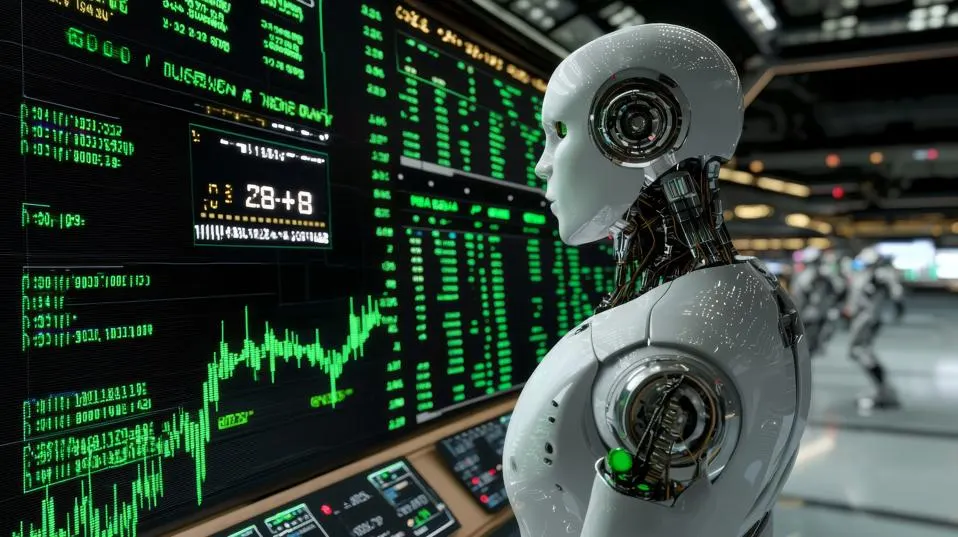
The stock market’s current AI euphoria, driven by companies like NVIDIA developing powerful processors for machine learning, might mask a more troubling reality. While artificial intelligence promises to revolutionize trading and risk management, it could paradoxically make our financial systems more fragile and susceptible to catastrophic failures.
“There’s so much euphoria, with tens or even upwards of a hundred billions of dollars being spent on AI. Every major investment bank on Wall Street is implementing it,” notes Jim Rickards, author of the new book Money GPT. However, he controversially asserts that this widespread adoption of AI in financial markets could amplify market crashes beyond anything we’ve seen before.
The Fallacy Of Composition
Rickards introduces a compelling concept called the "fallacy of composition" - where actions that make sense for individual market participants could spell disaster when adopted by everyone. He illustrates this with an analogy: "At a football game, one fan standing up gets a better view. That actually works. The problem is everyone behind them stands up, and next thing you know, the entire stadium is on their feet and nobody has a better view."
In financial markets, this phenomenon could manifest during market downturns. While it might be prudent for individual investors to sell during a crash, if AI systems controlling vast amounts of capital all execute similar strategies simultaneously, the result could be catastrophic.
The Missing Human Element
The author claims one of the most significant risks stems from removing human judgment from the equation. He points to the historic role of specialists on the New York Stock Exchange, who were tasked with maintaining orderly markets: "The specialist was supposed to stand up to the market when there was a wave of sellers... try to equilibrate the market." Today's AI systems, he suggests, lack this nuanced human judgment.
Speed And Synchronicity: A Dangerous Combination
While market panics aren't new, AI introduces unprecedented risks through its speed and synchronicity. The automated nature of AI-driven trading could accelerate market movements and create feedback loops that human traders might otherwise interrupt. As Rickards cautions, "What is new is the speed at which they can happen, the amplifying effect and the recursive function."
Beyond Market Crashes: The Banking System At Risk
The concerns extend beyond stock markets to the banking system itself. Rickards points to the recent collapse of Silicon Valley Bank as an example of how digital technology can accelerate bank runs. "That didn't work out over weeks and months. That happened in two days," he notes, suggesting that AI could further accelerate such events.
The Path Forward
While the author's warnings are stark, he emphasizes that the solution isn't to abandon AI entirely. Instead, he advocates for more sophisticated circuit breakers and regulatory frameworks. He suggests implementing "cybernetic" approaches that could gradually slow market activity during periods of stress rather than implementing sudden stops.
A Call For Balanced Innovation
As financial institutions rush to implement AI systems, Rickards' analysis serves as a timely reminder of the need for careful consideration of systemic risks. While artificial intelligence offers powerful capabilities for analyzing markets and managing risk, we must ensure these tools don't inadvertently make our financial systems more vulnerable to catastrophic failures.
The challenge ahead lies in harnessing AI's potential while implementing safeguards against its systemic risks. As financial markets continue their technological transformation, finding this balance may prove crucial for global economic stability.
Related Articles
How Google Cloud Put An AI Agent Inside Formula E’s GEN4 Car
At 150 miles per hour, there is very little time to ask an AI assistant where you are losing speed. Yet[...]
Why The AI Race Is Really An Infrastructure Race
The most dangerous mistake in the AI race is assuming that the smartest model will win it. For the past few[...]
The 5 AI Scaling Mistakes That Could Derail Your Business
AI pilots can make AI look deceptively manageable. Scale is where reality arrives. A system that works brilliantly for 50 people[...]
Tesco’s AI Agents Could Soon Do Your Shopping For You
Tesco, the UK’s largest supermarket chain, has spent 30 years learning what millions of people buy. Now it wants AI agents[...]
8 Companies Proving AI Can Deliver Real ROI
Most businesses are investing in AI. Far fewer can prove that it is actually paying off. An MIT study found that[...]

How Insilico Medicine Is Using AI To Reinvent Drug Discovery
Drug discovery has always been one of the slowest and most expensive games in business, often taking around a decade and[...]

Sign up to Stay in Touch!
Bernard Marr is a world-renowned futurist, influencer and thought leader in the fields of business and technology, with a passion for using technology for the good of humanity.
He is a best-selling author of over 20 books, writes a regular column for Forbes and advises and coaches many of the world’s best-known organisations.
He has a combined following of 4 million people across his social media channels and newsletters and was ranked by LinkedIn as one of the top 5 business influencers in the world.
Bernard’s latest book is ‘Generative AI in Practice’.
Social Media