

Davos 2026: Jensen Huang On The Five Layer AI Cake, The AI Bubble And Key AI Breakthroughs
17 March 2026
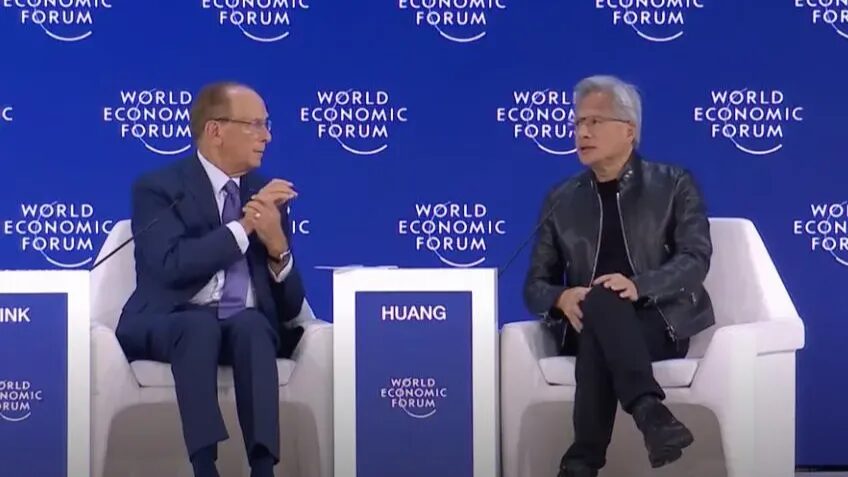
After Yuval Noah Harari’s talk was my highlight of day one at Davos, sitting in on this conversation became my highlight of day two. Jensen Huang provided exactly what’s needed right now: a clear framework for understanding what’s actually happening. In his conversation with BlackRock CEO Laurence Fink, he laid out why the AI revolution we’re experiencing goes far deeper than the chatbots and image generators most people associate with artificial intelligence.
Maybe not surprisingly, Huang framed the entire conversation around infrastructure, which is exactly where NVIDIA sits in the value chain. But the scale he described gives the argument real weight: hundreds of billions already invested, trillions more needed and physical evidence everywhere from TSMC’s 20 new chip plants to skyrocketing GPU rental prices for hardware two generations old.
The Five Layer Cake That Changes Everything
Huang described the AI infrastructure stack as five distinct layers. At the bottom sits energy. Above that comes chips and computing infrastructure, where NVIDIA naturally plays a central role. Then, cloud infrastructure, followed by AI models (where most people think AI lives), and finally the application layer on top.
The economic value gets created at that top layer, he emphasized. "This application layer could be in financial services, it could be in healthcare, could be in manufacturing." But you can't build that top layer without everything underneath it. And those foundational layers require massive capital investment. We're talking hundreds of billions already deployed, with trillions more needed, according to Huang.
He mentioned that TSMC just announced 20 new chip plants. Foxconn, Wistron and Quanta are building 30 new computer plants. Micron has committed $200 billion in the United States alone.
This is infrastructure investment on a scale that reshapes economies, creates entirely new industrial ecosystems and transforms labor markets. When Fink asked whether we're in an AI bubble, Huang's response was telling: try renting an NVIDIA GPU right now. "It's so incredibly hard, and the spot price of GPU rentals is going up, not just the latest generation, but two generation old GPUs." Rising prices for older hardware would suggest supply constraints rather than speculative excess.
From Pre-Recorded Software To Real-Time Intelligence
Huang explained what makes this platform shift fundamentally different from previous computing revolutions: Traditional software was essentially pre-recorded, and humans would write algorithms describing exactly what the computer should do with structured information organized in neat database tables.
The new computing paradigm processes unstructured information in real time. "Now we have a computer that can understand unstructured information, meaning it can look at an image and understand it. It could look at text and understand it's completely unstructured," Huang said. "It could listen to sound and understand it, understand the meaning of it, understand the structure of it and reason about what to do about it."
This shift from pre-programmed instructions to contextual reasoning represents a genuine new phase. AI systems can now take environmental context, understand your intent expressed however you choose to express it and perform tasks accordingly. As Huang put it: "AI is software that doesn't need to write software. You don't write AI, you teach AI."
That distinction matters enormously for how we think about the future of work, education and economic development. If software creation becomes about teaching rather than programming, the barriers to entry drop dramatically while the potential applications expand exponentially.
Three Breakthroughs That Changed The Game
Huang identified three major developments in the last year that transformed AI from an interesting technology into a genuine economic force. First, models became significantly more grounded. Early language models hallucinated frequently and couldn't be trusted for serious work. Now these systems can research, reason through unfamiliar circumstances, break down problems step by step and actually perform reliable tasks.
Second, open models emerged as a transformative force. Huang pointed specifically to DeepSeek's release as a pivotal moment. "DeepSeek was a huge event for most of the industries, most of the companies around the world, because it's the world's first open reasoning model," he explained. This democratization enabled companies and researchers to build domain-specific applications without having to start from scratch.
The third breakthrough was physical intelligence. AI systems now understand far more than language. They're learning protein structures, chemical interactions, fluid dynamics, particle physics, quantum mechanics. "Proteins is essentially a language," Huang noted. "And so all of these AIs are now making such enormous progress that these industries, industrial companies, whether it's manufacturing or drug discovery, are really making great progress."
His example of NVIDIA's partnership with Eli Lilly illustrates the point perfectly. Pharmaceutical companies that once devoted their entire R&D budgets to wet labs are now investing heavily in AI supercomputers because AI can interact with protein structures the way we interact with ChatGPT.
Europe's Opportunity In The Physical AI Revolution
When Fink pressed Huang about Europe's role in this transformation, his answer should resonate with European policymakers. "Your industrial base is so strong," Huang emphasized. "The industrial manufacturing base in Europe is incredibly strong. This is your opportunity to now lead past the era of software."
The United States dominated the software era, but AI changes the game. Because you teach AI rather than program it, and because physical AI is emerging as a major frontier, Europe's traditional strengths in manufacturing and deep science become strategic advantages. "Robotics is a once-in-a-generation opportunity for the European nations," Huang argued.
But there's a prerequisite: energy infrastructure. Huang was blunt about this requirement. "It's fairly certain that you have to get serious about increasing your energy supply so that you could invest in the infrastructure layer, so that you could have a rich ecosystem of artificial intelligence here in Europe."
This is the conversation many regions need to have. AI infrastructure requires energy at scale. Countries and regions that cannot or will not build that energy capacity will find themselves unable to participate in the foundational layers of the AI economy. And the danger is that they'll be perpetual consumers of AI services rather than builders of AI infrastructure.
What The Application Layer Explosion Actually Means
An indicator Huang cited was venture capital investment patterns. 2025 saw over $100 billion in VC funding globally, one of the largest investment years in history. But the key detail is where that money went: AI native companies building applications in healthcare, robotics, manufacturing, financial services, etc.
"For the first time, the models are good enough to build on top of," Huang explained. This is the moment when AI transitions from research curiosity to economic engine. When application-layer investment explodes, it creates demand that cascades down through all five layers of the stack.
That cascading demand explains why we need trillions in infrastructure investment, why chip manufacturers are building dozens of new plants, why energy becomes a strategic resource and why skilled trade workers are suddenly in extraordinary demand. "That population of workforce is so strong here in Europe," Huang noted. "In a lot of ways, the United States lost that in the last 20 to 30 years."
Is AI Bubble The Wrong Question?
When Fink reframed the AI bubble question to ask whether we're investing enough rather than too much, he captured something important about the AI revolution: The infrastructure requirements are genuinely massive because the opportunity is genuinely transformative.
Huang's response to bubble concerns was pragmatic: look at GPU rental prices and availability. When spot prices are rising for two-generation-old hardware, when every cloud provider is fully utilized, when demand keeps accelerating, that's not speculative excess. That's real companies doing real work creating real value.
"The AI bubble comes about because the investments are large, and the investments are large because we have to build the infrastructure necessary for all of the layers of AI above it," Huang explained. The scale isn't a warning sign. It's a requirement.
The Stakes Of Getting This Right
Fink's closing point highlighted a tension worth watching. "We need to make sure that the average pensioner here, the average saver, is a part of that growth," he argued. "If they're just watching it from the sidelines, they're going to feel left out."
Huang's response was characteristically direct: "We want to invest in infrastructure, right? Infrastructure is a great investment. This is the single largest infrastructure buildout in human history. Get involved."
Whether AI infrastructure actually represents the largest buildout in human history will become clearer over the next few years. What's already evident is that the capital flows are substantial and the strategic questions are real.
Having followed technology cycles for decades, I recognize that bold infrastructure claims often need time to prove themselves. Huang's five-layer framework provides a useful lens for evaluating where investments are flowing and why. But frameworks describe reality, they don't determine it. Nations, companies, and investors are making choices now about capabilities and positioning. Whether those choices prove prescient depends on how the actual buildout unfolds, which remains an open question.

Related Articles
What If AI Isn’t A Bubble, But It Still Crashes The Economy?
By now, “smart” versions exist of just about every home appliance, gadget and gizmos we can think of. However, manufacturers continue[...]

AI Swarm Attacks Are Coming, Is Your Business Ready?
By now, “smart” versions exist of just about every home appliance, gadget and gizmos we can think of. However, manufacturers continue[...]

Sign up to Stay in Touch!
Bernard Marr is a world-renowned futurist, influencer and thought leader in the fields of business and technology, with a passion for using technology for the good of humanity.
He is a best-selling author of over 20 books, writes a regular column for Forbes and advises and coaches many of the world’s best-known organisations.
He has a combined following of 4 million people across his social media channels and newsletters and was ranked by LinkedIn as one of the top 5 business influencers in the world.
Bernard’s latest book is ‘Generative AI in Practice’.
Social Media