

MWC 2026: The IQ Era Is Here, And These Are The Trends Every Business Leader Needs To Watch
10 March 2026
Three days on the floor of Mobile World Congress in Barcelona, in my role as Futurist in Residence for Nokia, confirmed something I have been watching build for some time: the AI revolution has stopped being a roadmap item and started being an operational reality, and the businesses that treat it as a future concern are already behind.
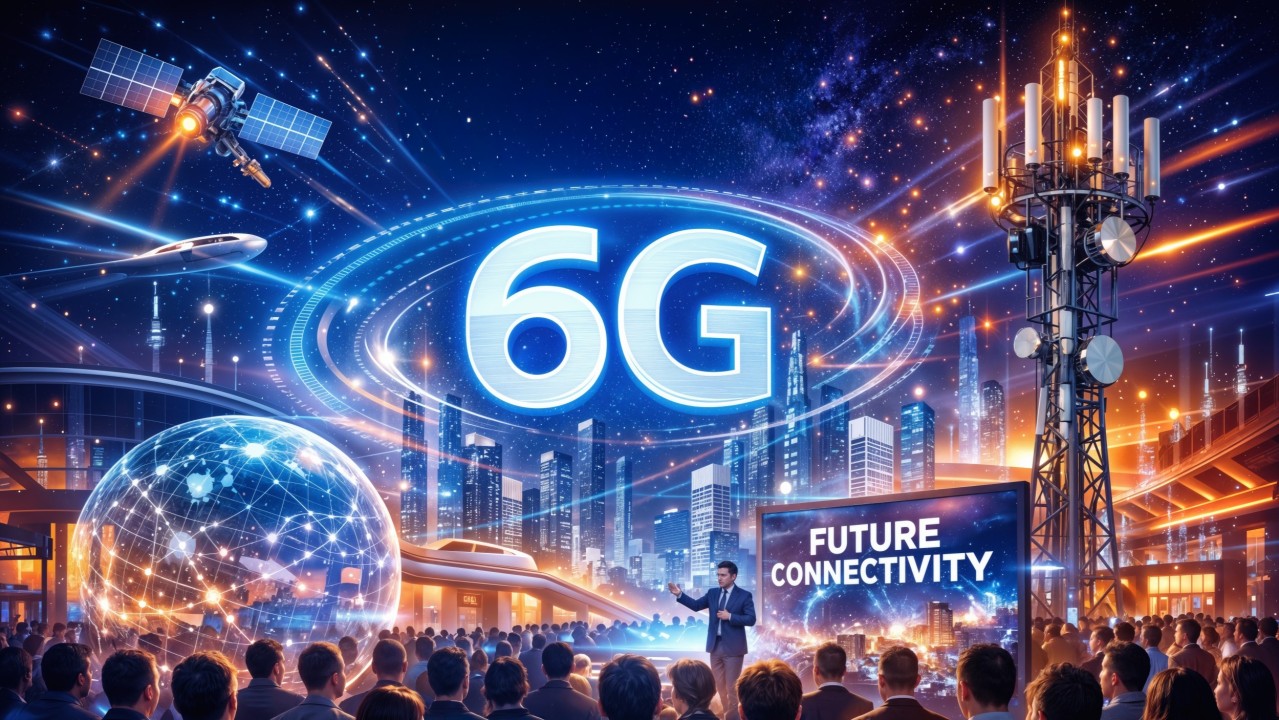
MWC 2026 carried the official theme of the IQ Era, and for once, a conference theme felt genuinely earned. Intelligence was everywhere, woven into the devices on display, the networks being demonstrated and the robots moving across the show floor. Here are the trends from MWC 2026 that every leader needs to understand.
Devices Are Getting Dramatically More Intelligent
The hardware story at MWC 2026 was about more than specifications. The direction of travel was clear from the moment you walked the show floor: our primary computing devices are being redesigned from the ground up for an AI-first world.
Tri-fold smartphones that unfold into a full 10-inch tablet. Devices thin enough and durable enough to replace a laptop entirely. Screens that are waterproof, creaseless, and brighter than anything available even two years ago. The physical form of the smartphone, which has remained broadly stable for over a decade, is fracturing into specialized categories, each optimized for different kinds of interaction.
The more significant development, though, was what is happening inside these devices. Generative AI is now being built directly into the hardware, enabling users to create photos, music and video from simple text prompts, on the device, without a cloud round-trip. The processing power available on a phone in 2026 would have required a server rack five years ago.
Agentic AI was arguably the biggest buzzword of the entire show, and its arrival inside consumer devices marks a genuine shift. Where generative AI responds to your requests, agentic AI takes actions on your behalf. It coordinates across apps, books things, sends messages, manages workflows, all without you initiating each individual step. The phone is becoming less of a tool you operate and more of an assistant that operates alongside you.
Smart Glasses Are The Interface Shift I Found Most Profound
If one technology surprised me at MWC 2026, it was smart glasses. The category has existed in various forms for years, but what is on display now feels really different from anything that came before.
The latest generation, from companies including Meta and Alibaba's Qwen, combine real optical displays with always-available AI in a form factor that people will actually wear. Point them at something and ask a question. Navigate hands-free while keeping your attention on the world around you. Have a live conversation translated in real time, in both directions, with the translation appearing in your field of vision. Use them as a teleprompter while you're on stage or in a meeting. The use cases are practical, immediate, and genuinely compelling.
What this represents at a deeper level is a shift in how humans interface with information. For fifteen years, that interface has been a rectangle of glass in your pocket. Smart glasses move it somewhere far more ambient, layered directly onto your lived experience rather than demanding you look away from it. The content we consume is becoming immersive and interactive in ways that feel genuinely new, and MWC 2026 was the moment that transition started to look inevitable rather than speculative.
Physical AI Has Left The Lab
Physical AI was impossible to ignore at MWC 2026. Humanoid robots were not tucked away in demonstration corners; they were on the main show floor, dancing, performing tasks, assisting visitors, and drawing substantial crowds. Industrial automation systems were showing real-time decision-making in simulated factory environments. Connected and autonomous vehicles featured across multiple stands.
The significance here goes beyond novelty. Physical AI, where machine intelligence controls or coordinates real-world systems and objects, places entirely different demands on the technology stack than software AI. A language model that gives you a slightly imperfect answer is acceptable. A robot operating in a factory, or a vehicle navigating a road, needs something far closer to certainty, and far closer to zero latency.
This is the wave of AI development that will most visibly reshape how physical industries operate, from manufacturing and logistics to healthcare and agriculture. The demonstrations at MWC 2026 made clear that the transition from lab to deployment is already underway, and that the infrastructure required to support it at scale is where the next major investment battle will be fought.
The Infrastructure Question Every Business Leader Needs To Ask
Beneath every headline trend at MWC 2026 was an important foundational theme, and one that most general business leaders are less aware off: the network infrastructure that carries all of this AI activity was not designed for what is now being asked of it.
For thirty years, global networks were built to push content toward consumers. Streaming video. Downloading files. The dominant flow was downstream, from server to device. AI fundamentally inverts that model. Generative AI requires massive volumes of data flowing upward to the cloud for processing. Agentic AI generates continuous machine-to-machine traffic, with systems coordinating with systems autonomously. Physical AI demands ultra-low latency for real-time decision-making that current networks were never engineered to support.
The response from network companies at MWC 2026 was clear: networks need to become AI-native. That means something more specific than simply faster or larger. It means redesigning networks from the ground up so that AI capability is built into the fabric of the network itself, rather than layered on top of it afterward.
One of the most significant architectural shifts discussed at the show was the move toward putting GPU compute directly into the network. This enables edge AI, where intelligence can operate close to where data is generated, rather than requiring every request to make a round-trip to a distant data center. The partnership between Nokia and NVIDIA, which saw NVIDIA become a significant Nokia shareholder last year, is the clearest expression of where this is heading: the mobile network node becomes an AI compute platform, delivering AI capability at the edge, not merely a connectivity pipe.
The implication for any organization building an AI strategy is straightforward: the infrastructure foundation has to be considered alongside the AI capability itself, or the capability will underperform.
What The IQ Era Actually Means For Business
The IQ Era is a useful frame precisely because it captures something specific: intelligence is becoming infrastructure. In the same way that electricity or internet connectivity became prerequisites for operating a modern business, AI capability is moving from competitive advantage to baseline requirement.
The companies at MWC 2026 that impressed most were the ones treating AI as foundational rather than additive. Deutsche Telekom demonstrated AI agents running autonomously across live networks. Colt Technology showed agentic AI cutting enterprise pricing workflows from several days to around ten minutes. Nokia's own demonstrations showed networks that can sense, adapt and optimize in real time, without human intervention at each step.
These are live deployments, with commercial timelines, generating measurable results. The gap between organizations that have made AI foundational and those still treating it as a project is widening faster than most leadership teams appreciate.
The single clearest takeaway from MWC 2026 is this: the AI era will be won by organizations that invest in the full stack, from the models and agents at the top to the networks and infrastructure at the bottom. The most sophisticated AI in the world cannot perform if the network carrying it was designed for a different era. Getting the foundation right is not a technical detail. It is a strategic imperative.


Related Articles
How Do You Manage AI Agents Before Your Tech Stack Spins Out of Control
By now, “smart” versions exist of just about every home appliance, gadget and gizmos we can think of. However, manufacturers continue[...]

What Are The Real Questions Leaders Will Be Asking At Davos 2026?
By now, “smart” versions exist of just about every home appliance, gadget and gizmos we can think of. However, manufacturers continue[...]

Sign up to Stay in Touch!
Bernard Marr is a world-renowned futurist, influencer and thought leader in the fields of business and technology, with a passion for using technology for the good of humanity.
He is a best-selling author of over 20 books, writes a regular column for Forbes and advises and coaches many of the world’s best-known organisations.
He has a combined following of 4 million people across his social media channels and newsletters and was ranked by LinkedIn as one of the top 5 business influencers in the world.
Bernard’s latest book is ‘Generative AI in Practice’.
Social Media