
The New AI Career Divide Is Already Starting To Show
4 June 2026
I’m sure you’ve heard this before:
“AI won’t replace people. People who use AI will replace people who don’t.”
No one is sure who (if anyone) said it first, perhaps Sam Altman or Jensen Huang. But since it became clear that the AI revolution is truly underway, it’s become a familiar phrase.
As a prediction and model for how workforces will react to the automation of everyday information work, it’s compelling.
And some feel that it also serves as a smokescreen, enabling businesses to lay off staff by claiming they weren’t properly skilled, while the real aim is simply to reduce costs.
But is it actually happening?
Three years on from the launch of ChatGPT, we’re getting a clearer view of the real implications of AI in the workplace. Rather than prediction and speculation, we see real-world change and transformation starting to happen.
There have been mass layoffs, reskilling drives and government initiatives aimed at transforming entire regions into hotbeds of AI talent and innovation.
But has adopting AI into your working life really become the golden ticket to future-proofing your career or business? Let’s take a look.
Why Will People With AI Skills Be So Valuable?
Right now, the AI that’s most valuable to businesses is AI that can automate routine tasks, complete work more quickly and efficiently, or create new opportunities and business models.
In theory, workers skilled with AI tools should be able to complete many tasks more quickly than those who aren’t.
The biggest winners, though, are those who can use AI not just to work more efficiently, but to rethink their job from the ground up.
Take software engineering, for example. This is a field where AI has already been highly disruptive, with claims that entry-level jobs are disappearing and senior developers are becoming more productive.
The low-hanging fruit, like using AI to generate boilerplate code and fix bugs, creates a straightforward path to efficiency and productivity gains, in theory at least.
But engineers who realize that AI effectively puts an entire virtual workforce at their command, enabling them to act more like project architects or orchestrators, fundamentally change what they’re able to accomplish.
Likewise, an HR professional can score quick wins using AI to screen CVs, draft job descriptions and handle routine employee queries. They will cut the time they spend on repetitive work and, hopefully, become more productive in other ways.
But if they can use it to implement end-to-end workforce management systems, make data-driven predictions about hiring needs, create personalized employee development paths and continuously optimize workforce performance, a new world of possibilities opens up.
Or consider a teacher. They can create more free time to spend face-to-face with students by automating marking and the creation of teaching materials. But by creating personalized learning journeys for individual students, or spotting opportunities to intervene earlier when lessons aren’t being fully absorbed, they can create entirely new education experiences.
So, the theory is sound. But the critical question is, how is this actually playing out in practice? Are workplaces becoming dominated by AI-augmented super-workers, or is AI just being used as an excuse to cut jobs?
And Has This Happened?
Well, as you might expect, the answer is nuanced.
There’s certainly evidence that AI skills are impacting hiring. In 2025, Data from PwCwas already showing that workers with AI skills command a 56 percent wage premium over those doing the same job but without AI skills. This had increased from just 25 percent the previous year.
Other studies have shown that candidates who list AI skills on their resumes are between eight and fifteen percent more likely to be shortlisted for an interview.
And one survey found that 72.8 percent of people with a household income of over £200,000 have increased their use of AI in the past year, suggesting increasing use is correlated with higher earnings.
But while there have certainly been workforce cuts related to AI, not much data is available on whether a lack of AI skills was a factor in people losing their jobs.
Barron’s reports that AI was cited in 25 percent of layoffs so far in 2026, compared to just 5 percent during the same period in 2025. Some, however, have questioned how accurate this is, bearing in mind that CEOs right now are under pressure to do two things: reduce costs and justify spending on AI.
But accurate or not, job cuts attributed to AI still only account for around five percent of the total layoffs in the US.
So, while it’s hard to argue that AI is causing widespread job losses just yet, it’s clearly influencing who gets hired, and where opportunities for humans are opening up or closing down.
So What Does This Mean For Me?
While there are signs that AI is impacting the employment landscape, it hasn’t manifested as the hugely transformational force that many are predicting. Yet.
It’s early days, though, and while the idea is more of a narrative than an operational reality right now, the direction of travel is clear.
AI skills are being used as a barometer of who is getting hired, who’s getting the highest pay and who is creating the most value for businesses. And as economic pressures force companies to continue to become leaner, more efficient and more innovative, the trend is likely to accelerate.
For those looking to understand how their job, profession or industry will be affected, I think the message is quite simple: Waiting for AI skills to become a requirement would be a mistake.
Anyone wanting to future-proof their career today should be looking at how AI will change their role, or the role they want, and working out how they can be a part of that change.
Related Articles

Tesco’s AI Agents Could Soon Do Your Shopping For You
Tesco, the UK’s largest supermarket chain, has spent 30 years learning what millions of people buy. Now it wants AI agents[...]

8 Companies Proving AI Can Deliver Real ROI
Most businesses are investing in AI. Far fewer can prove that it is actually paying off. An MIT study found that[...]

How Insilico Medicine Is Using AI To Reinvent Drug Discovery
Drug discovery has always been one of the slowest and most expensive games in business, often taking around a decade and[...]

How Goldman Sachs Is Using Agentic AI For Software Engineering At Scale
The financial services industry depends on data, speed and accuracy. Unfortunately, a significant portion of its digital infrastructure is not up[...]

What Is The Singularity And Are We There Yet?
The singularity has long been one of the most fascinating and frightening ideas in technology: a point when machine intelligence surpasses[...]
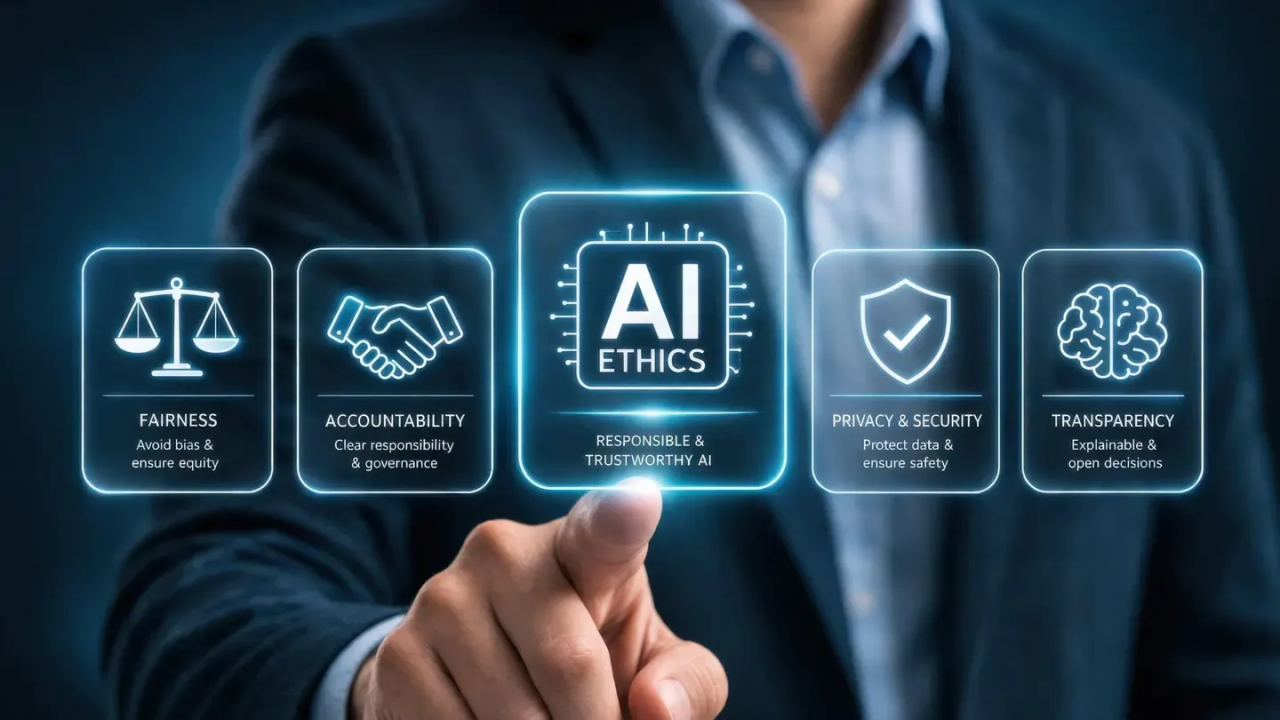
Why Responsible AI Could Be Your Biggest Competitive Advantage
Responsible AI is often treated as the price businesses must pay for using artificial intelligence. In reality, it could become one[...]

Sign up to Stay in Touch!
Bernard Marr is a world-renowned futurist, influencer and thought leader in the fields of business and technology, with a passion for using technology for the good of humanity.
He is a best-selling author of over 20 books, writes a regular column for Forbes and advises and coaches many of the world’s best-known organisations.
He has a combined following of 4 million people across his social media channels and newsletters and was ranked by LinkedIn as one of the top 5 business influencers in the world.
Bernard’s latest book is ‘Generative AI in Practice’.
Social Media