
What Are The Most In-Demand AI Skills?
20 June 2022
It’s predicted that 97 million jobs involving artificial intelligence (AI) will be created between 2022 and 2025. AI has the potential to transform every industry; however, businesses are still struggling to find employees with the skills necessary to create, train and work alongside intelligent machines.

As companies have become aware of the efficiency gains that can be achieved through leveraging the power of machine learning, computer vision, and similar technologies, demand for skilled workers in the field is quickly outstripping supply.
Colleges and universities have responded to this by creating new courses and educational programs focusing on these skills. But anyone wanting to break into the industry may still be confused at the options available to them. So here’s a run-down of some of the most valuable skills you can learn today if you want to be prepared to work with the automated, intelligent machines of the future!
Programming
Although no-code and low-code AI solutions are appearing that let us leverage AI solutions without getting our hands dirty, it’s likely that businesses that want to deploy their own bespoke AI solutions will require skilled coders for a long time yet. A basic understanding of at least one of the most popular programming languages for AI - Python, R, C++, and Java – is very useful for anyone working with machine learning algorithms. This may seem a little counter-intuitive – as the purpose of AI is to enable computers to “learn” without having to be specifically coded to carry out a job. Nevertheless, most people working in roles that involve AI today will recommend that some level of experience in coding is highly valuable for anyone wanting to prepare themselves for using AI.
Data Science
Data is absolutely fundamental to the ability of machines to think and learn. Data is the input used to train AIs to make decisions and carry out tasks. Data scientists understand how to capture, manipulate and work with data in order to extract insights from it. These skills are essential to the field of AI because they encompass the advanced analytics that are necessary in machine learning algorithms. Data science has been a part of computer science educational curriculums for a long time, and today they are usually heavily focused on applying AI to solving business problems using available information.
AIOps
This is a relatively new term that has emerged in recent years to cover the skills needed when it comes to working with the plethora of AI-related tools and services that have become available. AIOps involves administering and managing all of the connected systems that go into delivering modern AI infrastructure, in order to ensure continuous uptime and a good level of service to the end-user, which could be the business itself or its customers. It might involve coordinating the use of a number of AI-as-a-service elements that connect together to create the organization’s AI infrastructure. AIOps also refers to the process of administering or overseeing AI analytics of an organization’s IT and data operations. This could involve implementing machine learning processes to enable more efficient use of data within the organization or its IT infrastructure as a whole.
Statistics and Probability
These are old-fashioned mathematical skills that are still considered essential for anyone who wants to understand how AI works, why it is useful, and where it can be most usefully deployed. Techniques such as linear regression, logistic regression, clustering, Bayesian modeling, and random forest analysis were all around long before AI became a buzzword in business and industry and perform the core task of making predictions based on identifying patterns and spotting outliers. This is why they are still at the heart of many of the most sophisticated AI algorithms. Understanding the principles behind how they work is key to understanding why computers are such powerful tools when it comes to automating decision-making in businesses and other organizations. A firm understanding of statistics and probability is hugely valuable when starting out in AI, as it helps us to understand how to articulate problems and propose solutions by selecting the most appropriate models and techniques.
Communication and Visualization Skills
It’s great to be able to use computers to make decisions and attain a deeper understanding of complicated subjects than would ever be possible using purely human-scale analytics. However, if we don’t have the ability to communicate those findings to other humans – and explain why they are so valuable – then it’s all a waste of time. Many organizations have proven that it’s possible to bring about widescale, positive change – both internally and across societies as a whole – by utilizing AI and machine-driven decision-making. But communication skills are essential to generating the buy-in necessary to reap the benefits. This is the reason that “data communicators” and “data translators” are one of the most in-demand sets of skills when it comes to AI and machine learning in business right now. Strong visualization skills means the ability to take the insights uncovered by machine learning tools and convert them into compelling storytelling that communicates exactly what needs to be done, when, and by whom, in order to achieve growth and results.
Related Articles

AI Is Fueling A Flood Of Customer Complaints. Is That A Bad Thing?
Until recently, plenty of people with perfectly legitimate complaints never bothered to make them. They didn't [...]

Coca-Cola Is Using AI To Reinvent Marketing. Here’s What We Can Learn
Coca-Cola helped shape the modern image of Santa Claus. Its more recent[...]
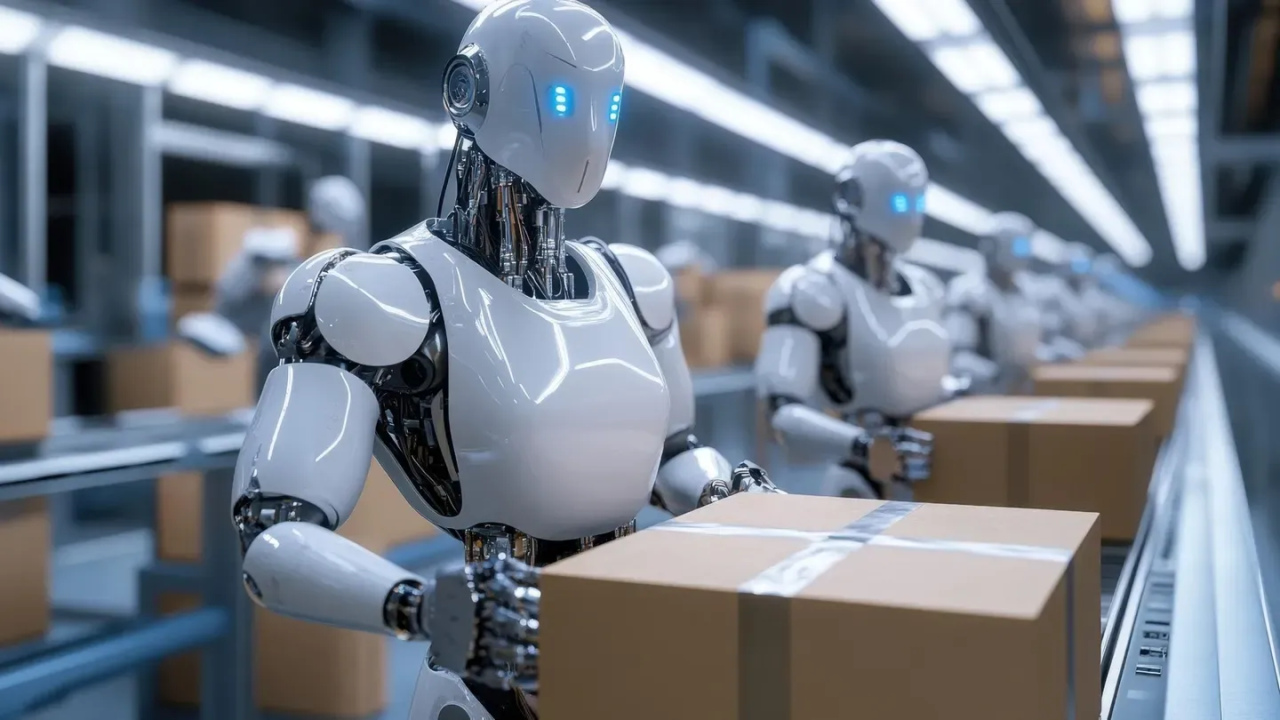
Humanoid Robots In 2027: What They’ll Do And What Could Go Wrong
Humanoid robots look great in demonstrations. In 2027, they’ll have to prove they[...]
10 Future Of Work Trends That Could Change Your Job In 2027
What happens when your next coworker is an AI agent, your boss is an algorithm, and the[...]

How Caterpillar Is Using AI To Reinvent Heavy Industry Without Replacing Workers
Caterpillar has been putting autonomous machines to work in some of the world’s toughest environments for more than 30 years. And[...]
What Happens When AI Learns To Improve Itself?
The most dramatic leap in AI could come when humans are no longer doing all of the improving. That is the[...]

Sign up to Stay in Touch!
Bernard Marr is a world-renowned futurist, influencer and thought leader in the fields of business and technology, with a passion for using technology for the good of humanity.
He is a best-selling author of over 20 books, writes a regular column for Forbes and advises and coaches many of the world’s best-known organisations.
He has a combined following of 4 million people across his social media channels and newsletters and was ranked by LinkedIn as one of the top 5 business influencers in the world.
Bernard’s latest book is ‘Generative AI in Practice’.
Social Media