
What If AI Isn’t A Bubble, But It Still Crashes The Economy?
14 May 2026
The AI bubble “doomer” narrative goes like this: if industry doesn’t see sufficient returns on the trillions being poured into AI, the fallout could plunge the world into recession.
But what if the real danger isn’t that AI fails, but that it works too well?
Analysts at Citrini Research recently explored this exact scenario. And while they point out that their work is a “stress test” rather than a prediction, this will do little to allay the fears of the 47 percent of Americans who believe AI’s impact will overall be negative.
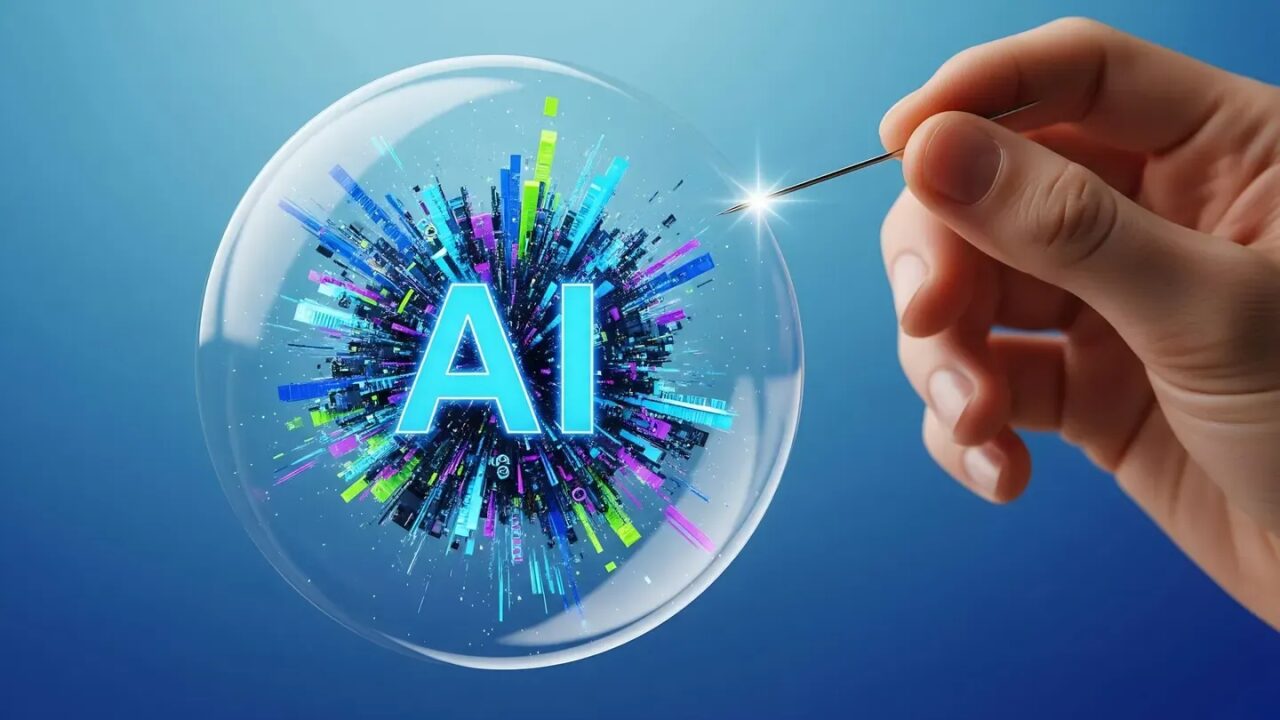
Rather than a sudden, worldwide crash into economic depression, the scenario proposes a more gradual erosion of quality of life, spending power, access to opportunity and political freedom, as wealth and power are increasingly concentrated in the hands of the corporations that control AI.
So, is the AI revolution taking us down a road that can only lead to economic collapse and dystopia, whether AI “works” or not? Or is it just a warning that we need to be extremely careful even when it looks like everything’s going to plan?
The Success Paradox
The simple premise behind the proposal is that modern economies are built around humans earning and spending money.
When large numbers of those earners are made redundant because of AI, the ripples could spread far beyond the specific industries being disrupted.
Knowledge workers — analysts, researchers, consultants, practitioners, engineers, and many more — generate huge amounts of society’s wealth and spending power. And in many cases, these are precisely the roles under threat. First, by reduction in headcount and, eventually, possibly by wholesale replacement.
Their value isn’t just the product of their labor but the resources they put into the wider economy: sustaining housing markets, generating tax revenue and supporting service industries.
We’re already seeing AI reducing headcount in these roles, and regardless of whether it increases productivity, it inevitably reduces human spending power.
The research suggests this could lead to a “feedback loop” as workers’ disposable income falls, and demand for consumer goods and services decreases. Businesses, facing a fall in revenue, accelerate their drive towards automation to further cut costs and improve margins, eventually spiraling towards economic crisis.
This doomsday scenario doesn’t preclude the possibility that AI will generate enormous economic benefits. By default, however, those benefits will go to the companies controlling the technology, driving increasing social inequality and widening the gap between rich and poor.
Realistic Or Doom-Mongering?
This may sound alarming, and it’s worth remembering that right now, data suggests the real-world impact of AI is still relatively limited.
While AI is routinely used to augment and accelerate human labor, there’s no real evidence that it’s replacing it on a large scale. In fact, OpenAI CEO Sam Altman recently said he is surprised the pace of adoption isn’t much faster.
This shouldn’t cause us to be complacent, as it could simply reflect the fact that we’re at an extremely early stage of the adoption cycle. Given how quickly AI has become more capable in recent years, it’s irrational to think that the tools and platforms available in five years won’t be massively more impactful than those we have today.
The fact that companies such as Accenture are pushing from the top to speed up adoption, often linking AI use to promotion and pay, makes this an increasingly likely scenario.
So, while the widespread economic disruption suggested by the Citrini research may seem far-fetched, the forces that could bring it about are already very much in play. To the extent that fear-mongering doomsday fantasy or not, failing to prepare for it seems like it could be a catastrophic mistake.
So What Can We Do?
Of course, fear and doom-mongering in the face of hugely transformative technological revolutions is nothing new. But it’s unusual to see anxiety induced not by the worry of things going wrong, but by the worry of things going right.
This is what makes the Citrini scenario important: it’s a reminder that human labor and spending power are the foundations of economies, and disrupting this status quo could have unpredictable and catastrophic consequences.
Right now, the question of how (or even if) AI should be regulated is a hugely political one. On one side, over-regulating risks missing out on benefits and handing economic advantages to rival nations. On the other hand, failing to put guardrails in place could transform economies and society in ways that could be hugely destabilizing.
One solution that’s frequently put forward is some kind of universal income, provided in some way by the companies making huge profits with AI. There’s a great deal of uncertainty around the political and societal implications of this, though, particularly if it was done on a large scale.
Ultimately, the danger is that AI will change the world faster than our economies, regulatory frameworks and societal systems are ready for.
So, the challenge isn’t to decide whether the scenario put forward by Citrini is right or wrong. It’s to accept that it’s one way things could play out, and include it in the range of eventualities we should prepare for.
This means businesses, governments, policymakers, and ourselves, as consumers of AI, should start thinking beyond short-term productivity gains and preparing for possible futures where AI both falls short of expectations and exceeds them in potentially dangerous ways.

Related Articles
How Do You Manage AI Agents Before Your Tech Stack Spins Out of Control
By now, “smart” versions exist of just about every home appliance, gadget and gizmos we can think of. However, manufacturers continue[...]

What Are The Real Questions Leaders Will Be Asking At Davos 2026?
By now, “smart” versions exist of just about every home appliance, gadget and gizmos we can think of. However, manufacturers continue[...]
5 AI Agent Mistakes That Could Cost Businesses Millions
By now, “smart” versions exist of just about every home appliance, gadget and gizmos we can think of. However, manufacturers continue[...]
Build Or Buy AI Agents: Why This Choice Matters More Than You Think
By now, “smart” versions exist of just about every home appliance, gadget and gizmos we can think of. However, manufacturers continue[...]

The Growing AI Backlash: Is The Revolution Over Before It’s Even Begun?
By now, “smart” versions exist of just about every home appliance, gadget and gizmos we can think of. However, manufacturers continue[...]

Stop Wasting Money On AI Agents: 5 Rules For Choosing The Right Use
By now, “smart” versions exist of just about every home appliance, gadget and gizmos we can think of. However, manufacturers continue[...]

Sign up to Stay in Touch!
Bernard Marr is a world-renowned futurist, influencer and thought leader in the fields of business and technology, with a passion for using technology for the good of humanity.
He is a best-selling author of over 20 books, writes a regular column for Forbes and advises and coaches many of the world’s best-known organisations.
He has a combined following of 4 million people across his social media channels and newsletters and was ranked by LinkedIn as one of the top 5 business influencers in the world.
Bernard’s latest book is ‘Generative AI in Practice’.
Social Media