
Workers Are Going On Strike Over Humanoid Robots, And This Is Just The Beginning
12 October 2026
When workers go on strike because they fear robots taking their jobs, the age of humanoid automation suddenly feels very real.
That is exactly what happened this summer at Hyundai’s Ulsan factory in South Korea, where workers staged partial strike action and made one demand particularly clear: Humanoid robots should not be introduced without their consent.
No humanoid robots are actually working there yet. Hyundai plans to begin introducing them in 2028, with robots moving into component assembly roles by 2030. But workers are already pushing back.
It is believed to be the first time plans to deploy humanoid workers have helped trigger industrial action anywhere in the world. It is unlikely to be the last.
Humanoid robots promise enormous productivity gains. They could take on repetitive, physically demanding and dangerous work while freeing people for tasks better suited to human capabilities.
The problem is that the technology may be advancing faster than society’s ability to deal with the consequences.
Companies are racing toward a future in which humanoid robots work alongside people, yet regulations, labor agreements and worker protections are still struggling to catch up. That makes Hyundai’s dispute more than a local labor disagreement. It could be an early warning of one of the biggest workforce battles of the coming decade.
The Unwritten Rulebook
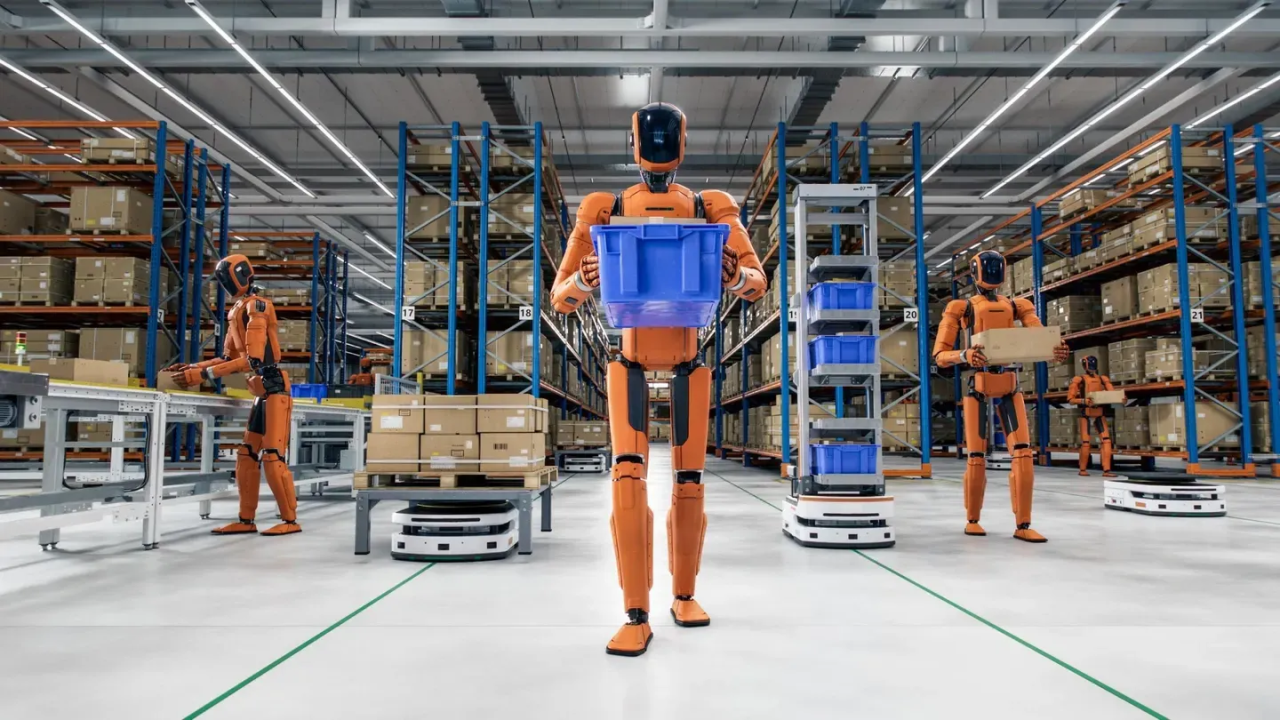
The robots causing the uproar are Atlas models, created by Boston Dynamics, which the carmaker acquired in 2020. According to the Seoul Economic Journal, banners demanding that human jobs should not be lost to robots were hung across the streets of Ulsan shortly after the plans were unveiled.
The truth is, robots are set to enter industries that have no real idea how they will deal with their impact. No country has passed legislation setting out rules or safeguards around how robots will move around factory floors alongside humans. And no company, publicly at least, has produced a credible plan to mitigate the impact on the lives of the people whose work they’ll take on.
The U.S. workplace safety regulator, OSHA, has yet to finish drafting the official ISO standard covering mobile robots that balance themselves, rather than being bolted to a factory floor like the robotic arms used in vehicle manufacturing since the 1960s.
At the same time, the Ulsan union is starting from a blank page when it comes to negotiating a labor agreement covering humanoids moving into roles traditionally carried out by humans.
Whatever form that agreement takes will be studied closely by corporations around the world, knowing they’re likely to face the same challenges themselves before long. Hyundai itself is likely to attempt to concede as little as possible, in order to capitalize on its billion-dollar acquisition.
Every transformative technology, from aviation to nuclear power and pharmaceuticals, has required a framework regulating the risks to human safety and society. In the case of humanoids, nothing like this exists yet, but many companies are pushing ahead to integrate them, meaning those hoping to make a profit are setting the agenda.
Humanoid Politics
The integration of humanoids into workforces is clearly as much a political and societal issue as a technological or industrial one. Yet until now these voices have been silent. As with the other transformative technologies mentioned above, there’s a “wait and see” approach. I would argue that here, the impact could potentially be much greater, and more damaging.
Anticipating the impact of this change, rather than simply reacting to it after it happens, is in everyone’s interests. If companies press on with change on this scale (Hyundai plans to deploy 25,000 Atlas units), governments will quickly find themselves facing further industrial action and wider public backlash.
This could result in restrictions and regulations that blunt the potential for growth and productivity gains offered by the technology, as well as a catastrophic collapse in the trust workers put in corporations to protect their interests and livelihoods.
Simply slowing down the adoption of technology isn’t likely to be the answer; it will only delay the inevitable. Instead, governments and society need to speed up their response, matching the breakneck speed with which industry is forging ahead.
Hyundai workers might be the first to protest, but millions of other manufacturing, logistics, retail and healthcare workers are likely to be behind them. If they don't see their interests protected, they'll register their objections on picket lines and at elections. And those driving digital transformation in industry will face a bigger challenge than industrial action at one Korean plant.
Frequently Asked Questions
Related Articles
Davos 2026: Jensen Huang On The Five Layer AI Cake, The AI Bubble And Key AI Breakthroughs
By now, “smart” versions exist of just about every home appliance, gadget and gizmos we can think of. However, manufacturers continue[...]

Why Prompt Engineering Isn’t The Most Valuable AI Skill In 2026
By now, “smart” versions exist of just about every home appliance, gadget and gizmos we can think of. However, manufacturers continue[...]
Letting AI Browse The Web For You Sounds Great Until It Goes Wrong
By now, “smart” versions exist of just about every home appliance, gadget and gizmos we can think of. However, manufacturers continue[...]
The 8 Data Trends That Will Define 2026
By now, “smart” versions exist of just about every home appliance, gadget and gizmos we can think of. However, manufacturers continue[...]

7 Quantum Computing Trends That Will Shape Every Industry In 2026
By now, “smart” versions exist of just about every home appliance, gadget and gizmos we can think of. However, manufacturers continue[...]

5 Business Trends Every Company Must Prepare for in 2026
By now, “smart” versions exist of just about every home appliance, gadget and gizmos we can think of. However, manufacturers continue[...]

Sign up to Stay in Touch!
Bernard Marr is a world-renowned futurist, influencer and thought leader in the fields of business and technology, with a passion for using technology for the good of humanity.
He is a best-selling author of over 20 books, writes a regular column for Forbes and advises and coaches many of the world’s best-known organisations.
He has a combined following of 4 million people across his social media channels and newsletters and was ranked by LinkedIn as one of the top 5 business influencers in the world.
Bernard’s latest book is ‘Generative AI in Practice’.
Social Media