

Humanoid Robots In 2027: What They’ll Do And What Could Go Wrong
17 November 2026
Humanoid robots look great in demonstrations. In 2027, they’ll have to prove they can do something less glamorous: a useful day’s work.
Robots have already been deployed in factories and warehouses, and manufacturers want to take them into hospitals and homes. Elon Musk has even predicted a future with billions of them, although that remains a long way from today’s reality.
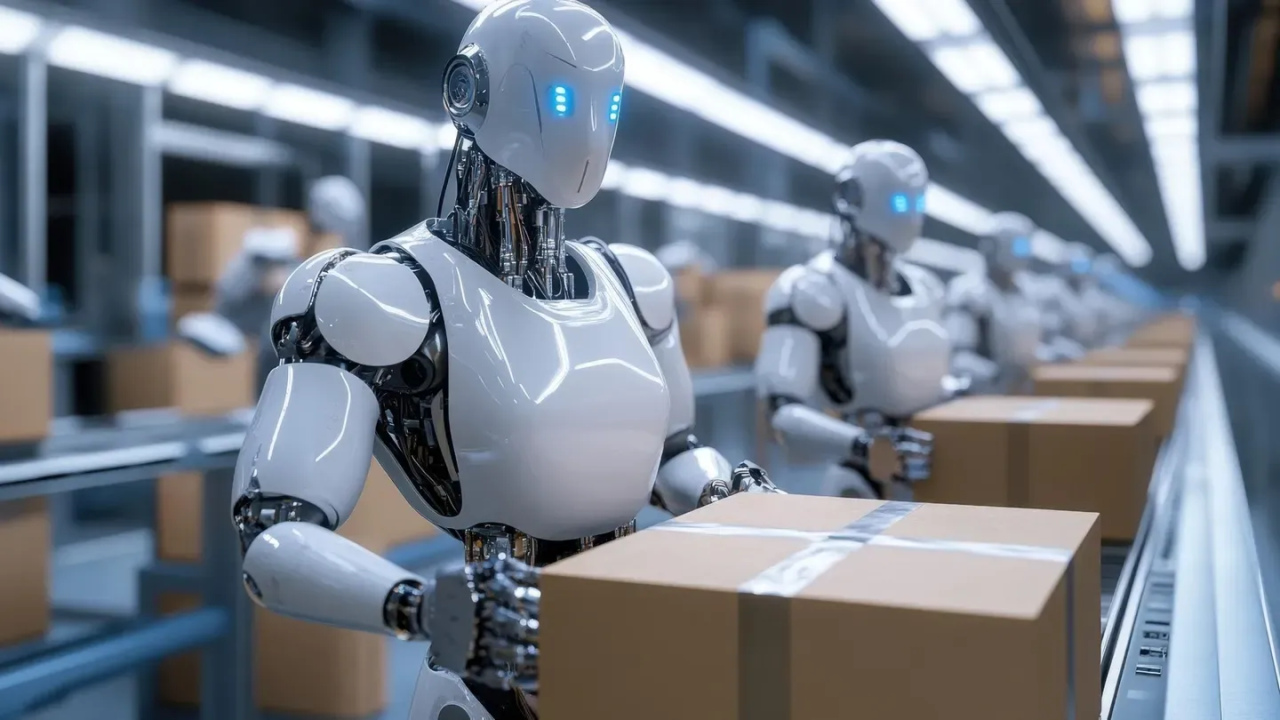
And while humanoids are grabbing headlines, the wider robotics revolution is gathering pace, too. From smarter hands and subscription models to training bottlenecks, privacy and accountability, here are the trends I expect to shape robotics in 2027.
Mass Manufacture
A prototype that performs beautifully on stage is one thing. Manufacturing thousands of machines that work safely, reliably and affordably is quite another.
Tesla has extensive mass-production experience, while Figure says its BotQ line is designed to manufacture up to 12,000 humanoids a year. China is already setting the pace: according to IDC, Chinese manufacturers accounted for more than 95 percent of global humanoid robot shipments in the first half of 2026.
The question for 2027 is who can turn ambitious production plans into dependable robots at scale. A spectacular product launch is little consolation when the warranty claims start arriving.
Getting Hands-On
A robot that can perform a backflip makes a great video. A robot that can reliably pick up a screwdriver may make a better employee.
In 2027, dexterity will be a major focus. Figure 03 uses palm cameras and pressure-sensitive fingertip sensors, while Boston Dynamics’ newest version of Atlas has tactile sensors across its hands.
These advances could make robots better at handling tools, fragile objects and other tasks that demand fine motor control, opening up work that has so far required skilled humans.
Robots-As-A-Service
Many businesses will probably rent their first humanoid robots rather than buy them.
Companies including Agility Robotics offer Robots-as-a-Service models, bundling hardware, software and support into recurring payments. At the consumer end, 1X advertises its NEO home robot for $499 a month, although early versions have limited autonomy and may need human assistance for some tasks.
Apparently, there was room for one more monthly subscription.
In 2027, these models could lower the barrier to adoption, but customers will need to understand exactly what their robots can do without help.
General-Purpose Humanoids
The goal is a humanoid that can move between roles, learn new skills and apply knowledge from one setting to another without being redesigned or reprogrammed for every task.
Manufacturers will keep pushing toward that goal in 2027, and progress could accelerate many of the other trends discussed here. It would also be a major advance in embodied AI.
But general-purpose physical intelligence remains a formidable challenge, and it would be premature to treat it as proof that artificial general intelligence, or AGI, has arrived.
Mastering a warehouse task and mastering the world are rather different achievements.
The Training Bottleneck
AI chatbots have learned from vast quantities of text, images and video. Robots must also understand gravity, friction, fragile objects and the countless unpredictable things people do in the physical world.
Unfortunately, real life does not come with a tidy training dataset.
High-quality records of physical interactions are still relatively scarce, so collecting more real-world demonstrations and creating realistic synthetic data will be essential.
The challenge in 2027 will be turning that data into robots that can adapt safely when the world refuses to follow the script.
Teleoperation, Privacy And Security
Some early home-assistance robots come with an important footnote: when they cannot complete a task, a human operator may be able to step in remotely.
Reportedly, this is part of the approach used by some consumer robots.
It raises obvious questions about consent, access and security. Who can look through your robot’s cameras, when are they allowed to do so, and what happens to the footage?
Help with the housework sounds appealing. An unseen audience in the living room, rather less so.
Clear safeguards for teleoperation will be an important issue in 2027.
Humanoids In Homes And Hospitals
Factories are relatively predictable environments. Homes contain children, pets, stairs and clutter. Hospitals bring vulnerable patients, sensitive data and even tougher safety requirements.
Robot makers will try to apply what they have learned in industrial settings to healthcare and the home, but success on a production line does not automatically qualify a machine to become a caregiver.
In 2027, proving that these robots can be trusted around people will matter at least as much as showing that they can perform useful tasks.
Robots And Accountability
The law is struggling to keep pace with the technology.
New ISO standards are being developed for dynamically stable industrial mobile robots, including machines that move and balance on legs.
But technical standards cannot settle every question.
If a robot damages property or injures somebody, who is responsible: the manufacturer, the software developer, the owner or the operator?
Businesses and policymakers will also face difficult questions about insurance, oversight and the impact on jobs.
Those answers are best worked out before a serious incident provides the incentive.
Two Legs Bad?
Not every job needs a humanoid, and looking beyond the hype will be an important trend in 2027.
Two arms and two legs make sense in spaces designed for people, but wheels, wings or multiple legs may be more effective elsewhere. Dogs, insects and birds have managed perfectly well without adopting the human form.
As the humanoid market gets more crowded, expect further innovation in robots that climb, crawl, hop and fly, often in places where human-shaped machines struggle.
The most useful robot of 2027 may be the one that never bothered to look human.

Related Articles

The Hidden Costs Of AI Data Centers, And Who Really Pays
Behind every AI chatbot query and autonomous agent action sits a data center, and the biggest ones consume staggering amounts of[...]

The AI Agent Boom Has A Trust Problem. Here’s How Business Leaders Can Fix It
The most expensive mistake your company makes next year could come from an employee who never sleeps, never takes a holiday[...]

Sign up to Stay in Touch!
Bernard Marr is a world-renowned futurist, influencer and thought leader in the fields of business and technology, with a passion for using technology for the good of humanity.
He is a best-selling author of over 20 books, writes a regular column for Forbes and advises and coaches many of the world’s best-known organisations.
He has a combined following of 4 million people across his social media channels and newsletters and was ranked by LinkedIn as one of the top 5 business influencers in the world.
Bernard’s latest book is ‘Generative AI in Practice’.
Social Media