
What I Learned At Cisco’s AI Summit, And Why It Changed How I Think About The Next 12 Months
10 February 2026
The most interesting AI conversations are happening in rooms where nobody is trying to sell you a slide deck, they are trying to solve real problems.
That was the energy at Cisco’s AI Summit, a day packed with candid discussions about what is working, what is stalling and what needs to change for AI to create durable value in real businesses. I left with my head full of ideas, and a deep sense of gratitude. I was truly honored to be among a very small number of people invited to attend in person, meet the speakers, and have the kind of unscripted conversations that happen between sessions and during the cocktail reception.
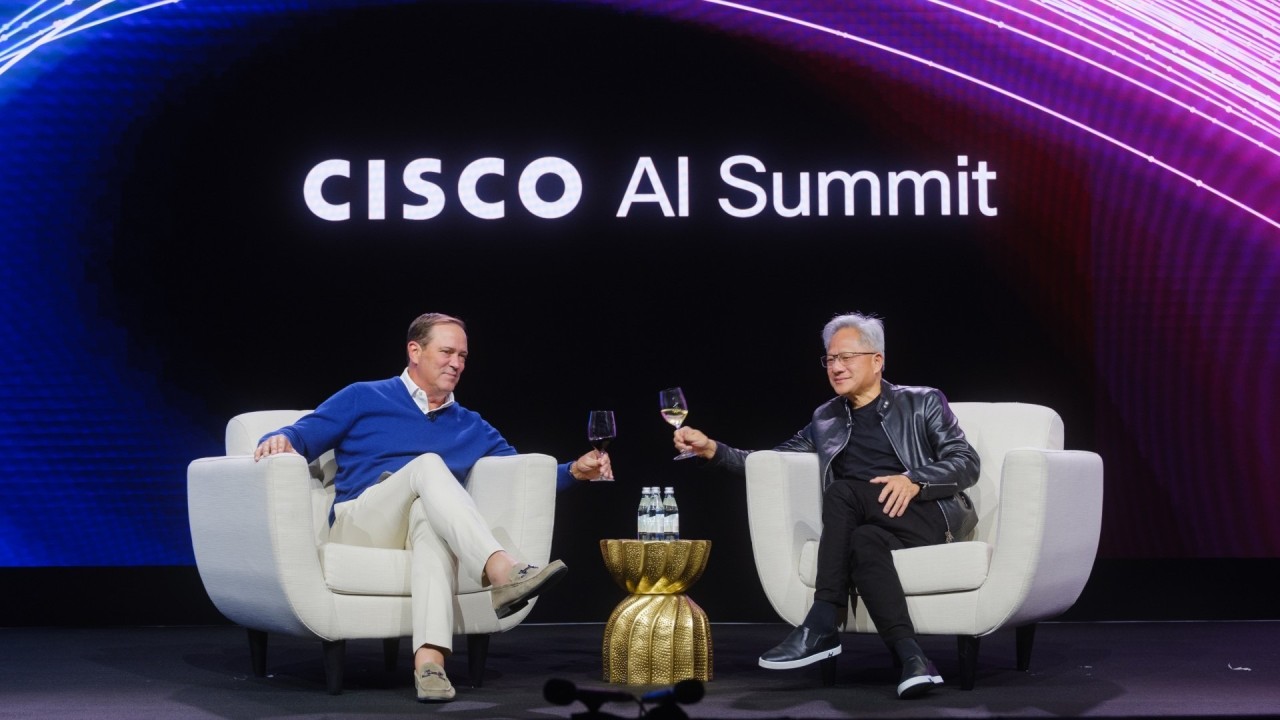
One personal highlight: sharing a glass of wine with Jensen Huang, founder and CEO of Nvidia. The public remarks were strong, the private conversations were even better. You could feel the weight of the moment. AI is changing how software gets built, how work gets organized, and how infrastructure gets financed and governed.
Here are the themes that stood out most, and why they matter for leaders who need to move from experimentation to impact.
Models Crossed A Threshold But The Absorption Gap Is The Real Battleground
Sam Altman’s comments captured a turning point that many leaders can feel. The models have crossed a capability threshold, and the interface and workflows are catching up. That combination is when adoption accelerates.
A consistent message throughout the day was that model progress is outpacing adoption inside companies. The tools are improving quickly, yet many organizations still struggle to translate raw capability into reliable workflows that people trust and use.
Kevin Weil, VP OpenAI for Science, captured it with a simple point, you cannot stand apart from AI and expect to keep up. The iteration cycle is too fast. The organizations that win will treat AI use as a daily habit across teams, rather than a special initiative owned by a small group.
That is also why leadership behavior matters so much. Francine Katsoudas, EVP and Chief People, Policy & Purpose Officer shared a striking adoption pattern, people who are not using AI tend to stay that way unless their leader intervenes. Adoption does not spread because of an email, it spreads because leaders model it and create the conditions for teams to follow.
Chuck Robbins reinforced the same idea from a CEO lens. You can embrace this wave, or you can get run over by it.

Agents Are Becoming The New Interface, And Trust Is The Constraint
The conversation kept coming back to agents, and the shift from asking AI for answers to delegating tasks with supervision.
There was broad agreement that the future is headed toward systems that can plan, use tools and complete multi step work across business functions. That does not mean humans disappear. It means the human role shifts toward intent, oversight, escalation and accountability.
One of the strongest statements came from Tareq Amin, CEO of Human, who described an internal approach where apps fade into the background and users declare intent. In that model, employees become policy setters and governors for agentic workflows. It is an ambitious direction, yet it matches what many leaders are already sensing, the interface is moving away from menus and forms toward intent and orchestration.
The obstacle is trust, especially in agentic environments. Leaders worry about agents doing the wrong thing, touching the wrong system, leaking data, or creating operational chaos. Matt Garman, CEO of AWS, used a simple analogy that landed well, teams move slowly across a narrow plank when there are no handrails, they move fast when guardrails exist. The lesson for leaders is clear, speed comes from safety mechanisms that people can rely on.
Physical AI Is The Next Frontier, And It Raises The Stakes
One of the most valuable threads of the day was physical AI, and the reminder that intelligence has to live in the real world, not only in text.
Fei-Fei Li’s focus on physical AI brings the conversation back to fundamentals. Useful intelligence depends on perception, context and a grounded understanding of the environment. That is the bridge from AI that drafts and summarizes to AI that can support care, manufacturing, logistics, field service and safety critical work. When AI can see and understand the world, it changes what automation can touch.
Infrastructure And Power Are Strategy Again
If you want a reality check on the AI era, stop talking about prompts and start talking about electricity, land, supply chains and build times.
A major theme across the day was that data center expansion and power availability have become strategic constraints. Software can move at AI speed, construction and permitting still move at physical speed.
Jensen Huang made the point that compute is becoming one of the most valuable resources, because demand for intelligence has no clear ceiling. That brings networking and security back to the center of the enterprise agenda, which is a core Cisco story.
The presence of leaders across the compute stack, including Intel CEO Lip-Bu Tan, was also a reminder that this era is shaped as much by silicon, systems engineering and efficiency as it is by model design.
Capability needs an engine, and the engine has physics, economics and supply constraints.
What I Am Taking Forward
I left the summit feeling optimistic, and also clear eyed about the work ahead. AI progress is impressive, yet business value depends on execution, trust and redesign.
The leaders who get this right will focus on absorption, not hype. They will treat AI as a capability that needs cultural adoption, workflow redesign and governance, rather than a tool that can be bolted onto yesterday’s processes. They will invest in guardrails that let teams move faster with confidence. They will pay attention to trust and they will think about infrastructure and power as strategic inputs, rather than background concerns.
Most of all, they will encourage high agency behavior, the willingness to try, learn, iterate and improve quickly. That trait came up repeatedly in different language, and it is a strong predictor of who will adapt well over the next year.
I am grateful for the conversations, the openness, and the chance to be in the room with people shaping what comes next.
👉 You can watch all of the amazing sessions on demand here: https://www.youtube.com/playlist?list=PLFT-9JpKjRTCc99zmlr8nSvp6H7QOVhCh
#CiscoPartnership #Sponsored #CiscoAISummit
Related Articles
Stop Wasting Money On AI Agents: 5 Rules For Choosing The Right Use
By now, “smart” versions exist of just about every home appliance, gadget and gizmos we can think of. However, manufacturers continue[...]
How To Rethink Your Job As AI Agents Reshape Work
By now, “smart” versions exist of just about every home appliance, gadget and gizmos we can think of. However, manufacturers continue[...]
AI Agents Lead The 8 Tech Trends Transforming Enterprise In 2026
By now, “smart” versions exist of just about every home appliance, gadget and gizmos we can think of. However, manufacturers continue[...]

7 Quantum Computing Trends That Will Shape Every Industry In 2026
By now, “smart” versions exist of just about every home appliance, gadget and gizmos we can think of. However, manufacturers continue[...]

5 Business Trends Every Company Must Prepare for in 2026
By now, “smart” versions exist of just about every home appliance, gadget and gizmos we can think of. However, manufacturers continue[...]
Technology in Action: My Key Takeaways on How AI and Quantum Are Accelerating Global Transformation
By now, “smart” versions exist of just about every home appliance, gadget and gizmos we can think of. However, manufacturers continue[...]

Sign up to Stay in Touch!
Bernard Marr is a world-renowned futurist, influencer and thought leader in the fields of business and technology, with a passion for using technology for the good of humanity.
He is a best-selling author of over 20 books, writes a regular column for Forbes and advises and coaches many of the world’s best-known organisations.
He has a combined following of 4 million people across his social media channels and newsletters and was ranked by LinkedIn as one of the top 5 business influencers in the world.
Bernard’s latest book is ‘Generative AI in Practice’.
Social Media