
AI Is Growing Up: What World Summit AI 2026 Revealed About The Future Of Business
27 October 2026
The AI industry is entering a new phase, where autonomous agents, business transformation, governance and human wisdom are taking center stage. Here are my biggest takeaways from World Summit AI 2026 in Amsterdam, and what they mean for business leaders.
Something has changed at AI conferences. A couple of years ago, we were collectively amazed that ChatGPT could write poetry, generate business plans and produce pictures of cats dressed as astronauts.
Today, we’re asking rather more serious questions.
I recently attended World Summit AI 2026 in Amsterdam, where I was working with Collibra, the enterprise AI control plane. Across the event, I heard from technology leaders, researchers and executives about the challenges and opportunities shaping the next phase of artificial intelligence.
My biggest observation? AI is growing up.
The conversation has shifted from demonstrating what AI can do to figuring out how we deploy increasingly autonomous systems safely, economically and at scale.
Here are seven themes that stood out to me.

1. Agentic AI Is Changing How Businesses Operate
Agentic AI was everywhere at the summit. We're moving from AI that answers questions and generates content toward systems that can plan, make decisions and take action.
Harrison Chase, co-founder and CEO of LangChain, discussed building agents that improve over time. But for me, the most interesting questions concern what happens when we introduce these agents into actual businesses.
How much autonomy should they have? What systems should they access? And how do we prevent an overenthusiastic AI agent from making decisions that someone later has to explain to the board?
I believe agentic AI has enormous potential, but businesses need to think much more carefully about how work gets done.
Giving an AI agent responsibility for an existing process might improve efficiency. Redesigning that process around what AI makes possible could deliver something far more valuable.
2. Businesses Need To Stop Automating Yesterday's Processes
One of my favorite presentations came from Brian Solis, Head of Global Innovation at ServiceNow.
He challenged businesses to think beyond what he called a finite mindset, where AI investments focus primarily on efficiency, cost reduction and doing existing tasks faster.
Instead, he encouraged an infinite mindset, where organizations rethink their operating models and explore entirely new opportunities.
I couldn't agree more.
Consider a company that uses AI to reduce the time spent creating marketing campaigns but leaves its approval, distribution and decision-making processes untouched. It might save hours creating content, only to create another bottleneck further down the workflow.
Solis argued that businesses need to redesign end-to-end workflows with AI at their core.
This is something I regularly emphasize when working with organizations. The biggest opportunities come from asking how we would design our businesses if we were starting from scratch today.
Otherwise, we risk spending billions on sophisticated technology to make outdated processes run slightly faster.
3. Governance Is Becoming Essential To Scaling AI
Another major theme was the growing importance of AI governance, particularly as agents gain more autonomy.
This was especially relevant to my work with Collibra at the summit.
One concept I find particularly useful is Collibra's approach to governed context.
Think about it. An AI agent might have access to enormous amounts of company data, but does it understand what that data means? Does it know where the information came from, whether it's accurate, who owns it and how it is allowed to be used?
These questions become critical when AI moves from generating recommendations to taking action.
For example, imagine an AI agent making decisions about insurance claims using inconsistent customer information or outdated policy definitions. The consequences could be considerably more serious than a chatbot producing an incorrect answer.
Collibra's focus on governing the full agent lifecycle delivers near real-time visibility, trust signals and built-in compliance, so teams can scale AI safely with measurable impact.
I believe this represents an important shift in how we think about governance. Businesses need effective controls built into how AI operates, enabling them to deploy increasingly autonomous systems with confidence.
And it raises another question: Who remains responsible when something goes wrong?
Giovanni D'Aniello, Group CIO at AXA, shared an interesting distinction between humans in the loop, who continue to execute parts of a process, and humans on the loop, who supervise agents, monitor their behavior and intervene when necessary.
I suspect this distinction will become increasingly important as businesses scale agentic AI.
4. AI Sovereignty Is Becoming A Geopolitical Priority
AI sovereignty featured prominently enough to warrant its own dedicated forum at the event.
Governments are increasingly concerned about who controls the technology underpinning their economies, public services and national security.
This includes data, AI models, cloud infrastructure, semiconductors and the computing power required to run increasingly advanced systems.
And there are some uncomfortable realities here.
A relatively small number of companies and countries control critical parts of the AI supply chain, creating significant dependencies.
For business leaders, sovereignty is also becoming a strategic consideration. Where does your AI run? Who controls the infrastructure? What happens if regulations, trade relationships or access to technology change?
I don't believe every country or organization needs to build everything itself. That would be enormously expensive and, in many cases, impractical.
But understanding these dependencies and deciding which capabilities need greater control is becoming essential.
5. AI Is Moving Into The Physical World
We've spent the past few years interacting with AI primarily through screens. That's beginning to change.
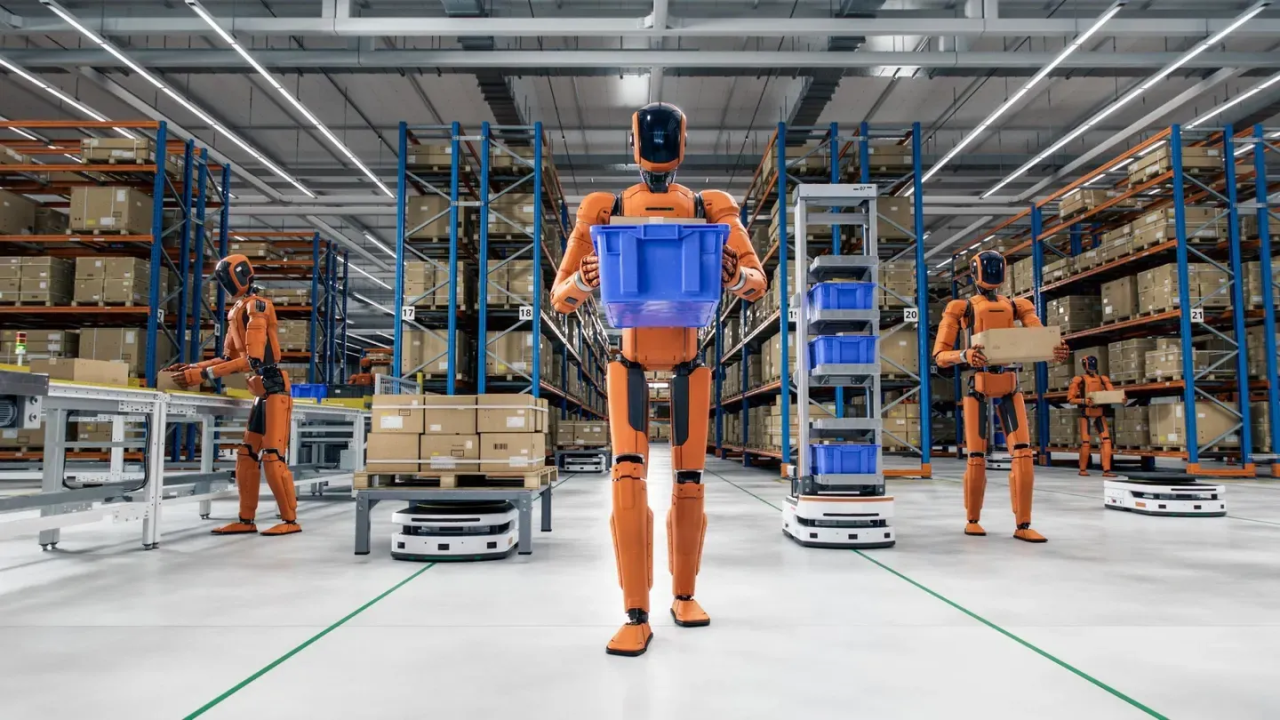
Physical and embodied AI were prominent themes at the summit, with growing interest in robots, autonomous machines and AI systems that understand and interact with physical environments (check out my video summary of the cool robots on show at the summit).
Advances in multimodal and world models are helping machines interpret visual information, understand their surroundings and increasingly translate decisions into physical actions.
The opportunities range from manufacturing and logistics to healthcare and scientific research.
Of course, getting a robot to perform reliably in unpredictable real-world environments is considerably harder than generating an impressive demonstration video.
But I believe physical AI could become one of the most transformative developments of the next decade.
6. The AI Race Is Increasingly About Infrastructure And Energy
Mark Papermaster, CTO and EVP at AMD, made another important observation about how AI computing requirements are evolving.
For years, much of the attention has focused on training increasingly powerful AI models. Now, as businesses deploy AI at scale, inference, the computing required to actually use those models, is becoming an increasingly significant workload.
This changes the economics of AI.
Training a model is expensive, but running millions of agents continuously, potentially making billions of decisions and executing complex workflows, creates enormous ongoing infrastructure demands.
The industry needs more efficient chips, better computing architectures, greater capacity and, critically, more energy.
I find it fascinating that one of the biggest constraints on our supposedly futuristic AI revolution could ultimately be something as old-fashioned as electricity.
The AI race is increasingly becoming an infrastructure and energy race.
7. Human Wisdom Could Become More Valuable Than Intelligence
Perhaps the most thought-provoking presentation came from Prabhu Narasimhan, founder and CEO of Brahma AI, who explored the distinction between intelligence and wisdom.
His argument was that intelligence is becoming increasingly abundant. Machines can solve complex problems, generate content and process information at extraordinary speeds.
But intelligence alone doesn't tell us whether something should be done.
Wisdom involves judgment, context, experience, values and understanding consequences.
As AI becomes capable of performing more intellectual tasks, these distinctly human qualities could become increasingly valuable.
I agree with this, although I would add that we shouldn't assume human judgment is automatically wise. Anyone who has attended enough corporate strategy meetings knows that intelligence and good decisions don't always arrive together.
Nevertheless, I believe our role is evolving.
We need people who can ask better questions, challenge assumptions, exercise judgment and ensure that powerful AI systems are working toward worthwhile outcomes.
The opportunity is to combine machine intelligence with human wisdom, rather than treating human involvement as an inefficiency to eliminate.
The Bigger Picture: AI Is Growing Up
Leaving Amsterdam, I felt enormously optimistic about AI's potential, but also increasingly aware of the challenges ahead.
The technology is advancing rapidly. Our ability to deploy it effectively, govern it responsibly and rethink our organizations around it is struggling to keep pace.
And perhaps that's the most important lesson from World Summit AI 2026.
We have spent years developing increasingly intelligent systems. Now we need to become much better at deciding what we want those systems to accomplish, what boundaries they should operate within and how we ensure their benefits translate into meaningful outcomes.
Because having incredibly intelligent AI that helps us do the wrong things faster would be a rather spectacular waste of human ingenuity.
#Sponsored
Frequently Asked Questions
Related Articles

The AI Cold War Is Here, And Every Business Will Feel The Impact
In 2026, the decisions that will impact the future of AI and business are increasingly being taken outside of boardrooms and[...]
Humanoid Robots Are Coming, Here’s What Everyone Needs To Know
More than one billion humanoid robots could be living and working alongside us by 2050. That is Morgan Stanley's forecast, and[...]
How Maersk Is Using AI To Survive The New Era Of Tariff Chaos
In recent years, chaotic and unpredictable changes to international trade tariffs and regulations have created turbulence for companies importing and exporting[...]

AI Girlfriends Are Reaching Children, And We Need To Talk About What That Could Mean For Boys
What happens when a boy learns about intimacy from a girlfriend who is always available, endlessly customizable and incapable of saying[...]
How Siemens Is Bringing Generative AI To The Factory Floor
Generative AI is moving out of the chatbot and onto the factory floor. Siemens is putting the technology to work to[...]

Sign up to Stay in Touch!
Bernard Marr is a world-renowned futurist, influencer and thought leader in the fields of business and technology, with a passion for using technology for the good of humanity.
He is a best-selling author of over 20 books, writes a regular column for Forbes and advises and coaches many of the world’s best-known organisations.
He has a combined following of 4 million people across his social media channels and newsletters and was ranked by LinkedIn as one of the top 5 business influencers in the world.
Bernard’s latest book is ‘Generative AI in Practice’.
Social Media