
How Google Cloud Put An AI Agent Inside Formula E’s GEN4 Car
14 September 2026
At 150 miles per hour, there is very little time to ask an AI assistant where you are losing speed.
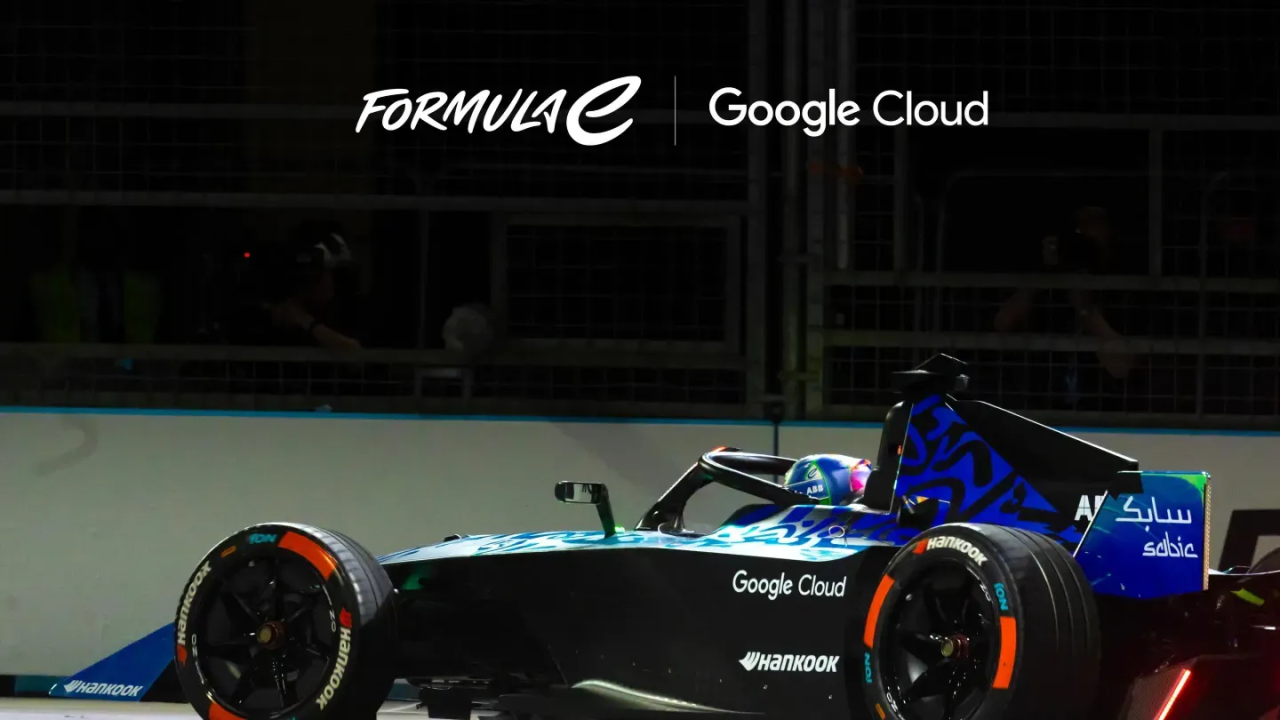
Yet that was essentially the experiment taking place at the 2026 Goodwood Festival of Speed, where Formula E driver Dan Ticktum attacked the famous hillclimb in the new GEN4 race car while Google Cloud technology analyzed what was happening around him.
The GEN4 is Formula E’s most powerful car yet, capable of producing up to 600kW, around 815hp, with permanent all-wheel drive and 0-100 kph acceleration in roughly 1.8 seconds. As Formula E Chief Marketing Officer Ellie Norman put it when I spoke to her at Goodwood, it is the “fastest accelerating single seater car on the planet,” a striking demonstration of how far electric racing technology has come. Ticktum eventually completed the Goodwood shootout in 42.46 seconds, one of the fastest times ever recorded on the famous hillclimb.
The more interesting story, however, was happening inside the cockpit.
AI Moves Into The Car
Mounted in the car was a Google Pixel 10 Pro running AI locally. The phone was connected to the car’s CAN bus, giving it access to telemetry from sensors distributed throughout the vehicle.
John Abel, Managing Director in Google Cloud’s Office of the CTO, explained the idea to me at Goodwood.
“We’re actually running a little micro agent on the actual phone,” he said. “That agent’s been calibrated for the things that Dan would like to know, like, ‘Where am I losing time? How’s my traction? How’s the balance from left to right?’”
The important shift is where the intelligence is happening. Much of today’s generative AI experience depends on sending information back to large cloud data centers. In this experiment, a small model could analyze information directly on a consumer device inside the car.
Abel said the system could, “within a matter of a second, give him immediate feedback in his earpiece.”
This is edge AI in a particularly unforgiving environment. The car is moving at extreme speed, generating huge amounts of data, and operating on a hot, dusty hill where connectivity cannot be treated as guaranteed.
From Gemma To Gemini
Formula E CTO Dan Cherowbrier told me the goal was to move intelligence closer to the point where decisions were being made.
“For the Goodwood challenge, what we wanted to do was get the AI insights a little bit closer to the driver,” he said.
The architecture combined Google’s Gemma model running on the phone with access to Gemini beyond the car. Cherowbrier explained that Gemma could analyze vehicle telemetry locally, while agent-to-agent communication could reach Gemini for additional information such as timing feeds or broadcast data.
That hybrid architecture is significant. Some AI tasks need the scale of the cloud. Others benefit from being processed locally because speed, resilience or data sensitivity are more important. Increasingly, intelligent systems will be designed to decide where a task should run and which AI agent should handle it.
Formula E is an ideal laboratory for this because performance is measured in fractions of a second. The sport has always positioned technology as part of the competition itself, and the Goodwood experiment pushes that philosophy into AI.
Why Edge AI Matters Beyond Motorsport
The wider business implications are easy to see.
Abel gave the example of manufacturing, where cameras and AI models embedded directly into production equipment could identify a displacement or fault and immediately alert an operator. Similar ideas apply to robots, vehicles, warehouses, energy infrastructure, healthcare devices and industrial equipment.
This is where AI starts to become part of the physical world. The intelligence sits closer to the machine, sensor or person making the decision, rather than waiting for every interaction to travel to a remote data center.
For companies, this creates a new design question. Instead of asking where they can add a chatbot, they can ask where local intelligence could remove delay, improve reliability or help people make better decisions in real time.
The Next Generation Of AI Will Be Embedded
Google Cloud and Formula E have already used AI together for race strategy, broadcast insights and previous engineering experiments. Goodwood showed another direction, AI becoming a live participant in an operating environment.
A racing car traveling up a narrow hill at more than 150 miles per hour is an extreme use case. That is exactly why it is useful.
If AI can interpret telemetry data, coordinate with other agents and return useful information to a driver under those conditions, it becomes much easier to imagine similar systems inside factories, vehicles, logistics networks and machines.
The next phase of AI will increasingly live inside the products and systems around us. Goodwood offered a very fast preview of what that future could look like.
Frequently Asked Questions
Related Articles
What Is The Singularity And Are We There Yet?
The singularity has long been one of the most fascinating and frightening ideas in technology: a point when machine intelligence surpasses[...]
Why Responsible AI Could Be Your Biggest Competitive Advantage
Responsible AI is often treated as the price businesses must pay for using artificial intelligence. In reality, it could become one[...]
Why The AI Infrastructure Race Is Moving Beyond GPUs
The AI revolution may be powered by algorithms, yet its progress increasingly depends on something far more physical: how many computers[...]
AI Tokenomics Explained: What Every Business Leader Needs To Know
Every time someone asks an AI model a question, summarizes a document or generates a piece of code, tokens are being[...]

5 Ways To Measure The True ROI Of AI Agents
AI agents are moving rapidly from experimental pilots into the heart of everyday business operations. But as investment accelerates, one critical[...]
How To Get Your Business Data Ready For AI Agents
Give an AI agent bad data, and it can make bad decisions at machine speed. AI agents are ushering in a[...]

Sign up to Stay in Touch!
Bernard Marr is a world-renowned futurist, influencer and thought leader in the fields of business and technology, with a passion for using technology for the good of humanity.
He is a best-selling author of over 20 books, writes a regular column for Forbes and advises and coaches many of the world’s best-known organisations.
He has a combined following of 4 million people across his social media channels and newsletters and was ranked by LinkedIn as one of the top 5 business influencers in the world.
Bernard’s latest book is ‘Generative AI in Practice’.
Social Media