Couldn’t find what you were looking for? Try a new search.
OKRs vs BSC: What is the Difference?
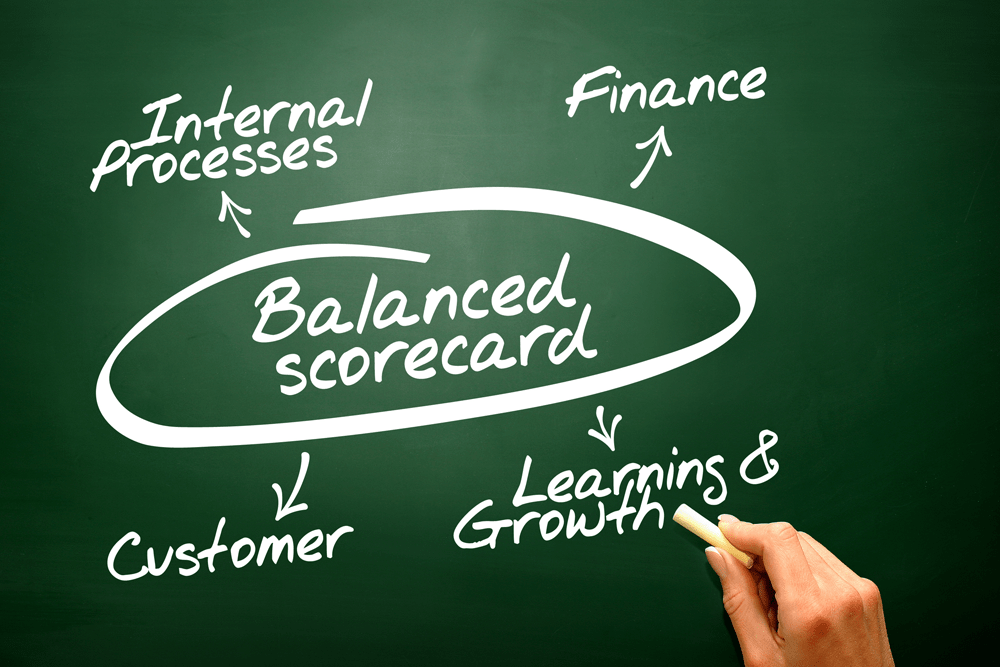
If you’ve read anything about strategy and performance management lately, you might have come across the phrase OKRs (which stands for Objectives and Key Results). I’ve certainly noticed that OKRs are suddenly gaining real momentum. However, some people have noted that the OKR approach is pretty similar to the Balanced Scorecard approach (or BSC for short). In this article, we’ll look at how OKRs and BSC differ – and what they could learn from each other. Defining OKRs and BSC Let’s start by clarifying what the terms OKR and BSC mean. The BSC is a strategy framework that sets out [...]

Why every company needs a plan-on-a-page
In order to be successful and deliver results, organisations need a good strategic plan that is concise, accessible and easy to understand. Many companies make the common mistake of thinking their plan has to be complex and lengthy for it to be “good”. In fact, the opposite is true. Your top level plan should be nothing more than a simple, at-a-glance description of where your organisation needs to go, and there’s no need for it to be more than one page long. The problem with strategy execution and communication Only 10% of companies manage to turn their strategy [...]

OKRs vs KPIs: What is the Difference?
Have you noticed that OKRs (management speak for ‘objectives and key results’) are getting a lot of attention lately? Credited with adding to the success of Silicon Valley companies like Google and Twitter, OKRs are making real waves in performance management literature. And for good reason. If you’ve heard anything about OKRs, you might be wondering how they differ from KPIs (key performance indicators). It’s certainly a question that I’m getting asked more and more. In this article, we’ll look at the distinction between OKRs and KPIs – and see how the two fit together. Digging into OKRs To start [...]

The 6 Biggest Technology Trends In Accounting And Finance
The explosion in data that has launched the Fourth Industrial Revolution, an era when business will be transformed by cyber-physical systems, has enabled several technology trends to develop. Every business can leverage these important trends and should pay attention to how best to use them, but accountants should really evaluate how these six technologies can be used strategically to achieve the company’s business strategy. 1. Big Data Data is crucial to make business financial decisions. Today, data isn't just numbers and spreadsheets that accountants have been familiar with for years; it also includes unstructured data that can be analysed through [...]

OKR vs MBO: What is the Difference?
MBO (which stands for “management by objectives”) has been a popular management tool for decades. But there’s an alternative approach that’s gaining a lot of traction at the moment: OKR (or “objectives and key results”). If you’ve read anything about OKRs, you might have noticed it has some distinct similarities to MBO. However, as we’ll see in this article, there are some clear differences between the two. Defining MBO MBO was formulated by Peter Drucker in his 1954 book The Practice of Management as a way to improve organisational performance. In essence, MBO describes a process of defining specific and [...]

What is NLP AI?
Recently, natural language processing (NLP) artificial intelligence has matured to the point that it is challenging to discern if you're communicating with a robot or a human if you're not face-to-face. Getting NLP to this point was an incredible feat and one that was made possible by advances in machine learning and allowed businesses to leverage it in countless ways. One of the most exciting—and challenging—developments in artificial intelligence was to figure out how machines could generate, and process language like humans do. A task that humans take for granted each and every day turned out to be a complex [...]

What are the Pros and Cons of Using OKR?
I’ve written before about how OKRs measure up against other strategy and performance management tools, like BSC, KPIs and MBO. But, if you’re entirely new to the OKR approach, I thought it might help to explore some pros and cons of using OKRs – and how to get the best out of OKRs in your organisation. Er, what the heck does OKR mean? Let’s start by defining what OKR actually is. The acronym stands for “objectives and key results”, which pretty much summarises what OKR is all about: setting out what you want to achieve (your objectives) and what success [...]

What is a KPI?
If you were to eavesdrop on just about any executive meeting, strategy session or performance review in any business, chances are you would hear the term ‘KPI’ mentioned many times. Most people in those discussions would know that the acronym stands for Key Performance Indicators, but if you pressed each person to explain what a KPI actually is, it’s likely that you would hear many different definitions. Therein lies the issue: KPIs are ubiquitous in modern business and yet the term is often overused and misunderstood. This means that, although KPIs are very common, businesses that are actually [...]

How AI And Machine Learning Are Transforming Law Firms And The Legal Sector
Whenever a professional sector faces new technology, questions arise regarding how that technology will disrupt daily operations and the careers of those who choose that profession. And lawyers and the legal profession are no exception. Today, artificial intelligence (AI) is beginning to transform the legal profession in many ways, but in most cases it augments what humans do and frees them up to take on higher-level tasks such as advising to clients, negotiating deals and appearing in court. What is artificial intelligence? Artificial intelligence mimics certain operations of the human mind and is the term used when machines are able [...]


3 Important Ways Artificial Intelligence Will Transform Your Business And Turbocharge Success
From the smallest local business to the largest global players, I believe every organisation must embrace the AI revolution, and identify how AI (artificial intelligence) will make the biggest difference to their business. But before you can develop a robust AI strategy – in which you work out how best to use AI to drive business success – you first need to understand what’s possible with AI. To put it another way, how are other companies using AI to drive success? Broadly speaking, organisations are using AI in three main ways: Creating more intelligent products Offering a more intelligent service [...]